tradermonty
Install Crypto Regime Analyzer
Pick your agent. Every command is ready to paste.
npx skills add tradermonty/claude-trading-skills --skill crypto-regime-analyzerThe open skills CLI detects your agents (Claude Code, Cursor, Codex and 70+ more) and installs to the right folder. Add -g to install globally.
01
Install it
Run the command above, or upload the folder in Claude.
02
Ask naturally
Describe the task. Your agent loads crypto-regime-analyzer when the request matches its description.
03
Name it if needed
If it does not trigger, say “use the crypto-regime-analyzer skill”. In Codex, type $crypto-regime-analyzer.
Crypto Regime Analyzer Skill
Purpose
Quantify the crypto market regime using a data-driven 6-component scoring system (0-100). This is the crypto analog of market-breadth-analyzer + exposure-coach: it answers "what posture does the crypto market currently support?" before any coin-level analysis happens.
Score direction: 100 = Maximum risk-on health (broad participation, healthy trend, sane leverage), 0 = Critical risk-off.
No API key required — uses CoinGecko's free public API and Binance's public futures endpoint.
When to Use This Skill
- User asks "Is crypto risk-on or risk-off right now?" or "How healthy is the crypto market?"
- User asks "Is it alt season?" or about BTC dominance direction
- User asks whether funding rates are overheated
- User wants an exposure posture for a crypto sleeve before screening individual coins
- User wants a daily crypto regime check alongside the equity
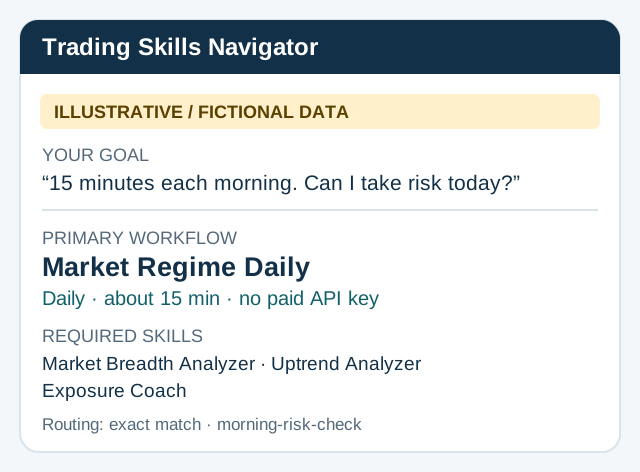
market-regime-dailyworkflow
What This Skill Does NOT Do
- No coin picks, no buy/sell signals, no price targets
- No execution or portfolio changes — regime description only
- Human decision gates remain central, consistent with the project vision
Prerequisites
- Python 3.9+ with
requests(live mode only; offline mode is stdlib-only) - Internet access to
api.coingecko.comandfapi.binance.com(live mode) - No API keys required
Component Model
| # | Component | Weight | Question it answers |
|---|---|---|---|
| 1 | BTC Trend Structure | 25% | Is the reserve asset's primary trend intact? (price vs 50/200DMA stack, 200DMA slope) |
| 2 | Alt Breadth Participation | 20% | How broadly are alts participating? (% of top-N above 200DMA, 50DMA confirmation) |
| 3 | BTC Dominance Regime | 15% | Where is capital rotating? (dominance direction interpreted jointly with BTC trend) |
| 4 | Perpetual Funding Regime | 15% | How crowded is leverage? (avg funding across majors; contrarian at extremes) |
| 5 | Drawdown & Volatility Position | 15% | Where are we in the cycle? (drawdown from 1y high, realized vol percentile) |
| 6 | Momentum Thrust / Washout | 10% | Short-horizon confirmation (% of universe positive over 30d) |
Missing components have their weight proportionally redistributed (same convention as market-breadth-analyzer). Full scoring logic: references/crypto_regime_methodology.md.
Regime Zones
| Score | Zone | Posture |
|---|---|---|
| 80-100 | RISK_ON | Broad risk-on conditions observed; review risk limits before decisions |
| 40-79 | NEUTRAL | Mixed conditions observed; no strong regime conclusion |
| 0-39 | RISK_OFF | Defensive market conditions observed; review existing risk controls |
These are heuristic descriptive bands, not validated allocation rules. See
references/VALIDATION.md for the current evidence boundary and the artifacts
required before making quantitative performance claims.
Execution Workflow
Phase 1: Run the Analysis Script
Live mode (fetches CoinGecko + Binance; first run of the day takes ~2-4 minutes at the default --top-n 20 due to free-tier rate-limit throttling; same-day re-runs hit the cache and are instant):
mkdir -p reports/<routine-or-date>
python3 skills/crypto-regime-analyzer/scripts/crypto_regime_analyzer.py \
  --output-dir reports/<routine-or-date>
Offline mode (no network; snapshot schema in the methodology reference):
python3 skills/crypto-regime-analyzer/scripts/crypto_regime_analyzer.py \
  --input-json snapshot.json \
  --output-dir reports/<routine-or-date>
Options: --top-n <int> universe size (default 20), --cache-dir <path> fetch cache location (default .crypto_regime_cache), --quiet.
Phase 2: Interpret the Output
The script writes crypto_regime.json (machine-readable, for chaining into other skills) and crypto_regime.md (one-page report), and prints a one-line summary:
CRYPTO REGIME: NEUTRAL (score 68.4/100) — Mixed conditions observed; no strong regime conclusion
When presenting results, lead with the zone and posture, then explain the 1-2 components most responsible for the score using their signal strings. Flag any components reporting data_available: false and what that means for confidence.
Phase 3 (optional): Feed Downstream
The JSON composite can slot into an exposure-coach-style posture summary as
one descriptive crypto-market input. It must not independently authorize,
block, size, or execute a trade.
Output
The script writes two artifacts to --output-dir and prints a one-line summary for workflow chaining:
crypto_regime.json— full machine-readable analysis:metadata, per-component results (score,signal,data_available, component-specific fields), and thecompositeblock (score,zone,guidance,effective_weights).crypto_regime.md— one-page report: composite score with zone bar, posture line, per-component table (weight / score / signal), and confidence notes.- Console:
CRYPTO REGIME: <ZONE> (score <N>/100) — <posture>plus warnings for any skipped components.
Resources
references/VALIDATION.md— validation status, evidence boundary, and reproduction requirements.references/crypto_regime_methodology.md— full scoring rationale, every threshold table, the offline snapshot JSON schema, and the live data-source endpoint list.scripts/crypto_regime_analyzer.py— CLI orchestrator (entry point).scripts/data_client.py— CoinGecko/Binance fetchers, per-day cache, dominance history accumulator, offline loader.scripts/calculators/— one module per component; pure functions, fully unit-tested.scripts/scorer.py— weighted composite with proportional weight redistribution.scripts/tests/— tests covering every component, the scorer, sparse-data fail-closed behavior, and end-to-end bull/bear/degraded snapshots.
Known Limitations
- Dominance history accumulates locally. CoinGecko's free tier only exposes current dominance, so the client stores one observation per run-day in the cache dir. The dominance component reports
data_available: falseuntil 31 daily observations exist (weight is redistributed until then). Seed it faster via--input-json. - Funding is best-effort. If Binance's endpoint is unreachable (geo-restrictions, outage), the component is skipped gracefully.
- Universe is top-N by market cap with stablecoins and wrapped/staked assets excluded; it is not a fixed index, so composition drifts with the market.
- Thresholds are heuristic and documented in the methodology reference; they are conservative defaults, not backtested optima.
Disclaimer
Educational and process-improvement use only. This skill describes market conditions; it does not provide financial advice, signals, or buy/sell instructions. All decisions remain the user's responsibility.
Tips for Crypto Regime Analyzer
- • Start a fresh session after installing so your agent picks up the new skill.
- • This skill ships scripts. Read them before the first run, and run it in a project without secrets first.
- • It bundles reference files. The agent reads them only when needed, so they cost no context until then.
- • It is part of a pack with 30 skills. Install only the ones you need with --skill to keep triggers precise.
- • If two skills overlap, mention the one you want by name.
Questions about Crypto Regime Analyzer
What does the Crypto Regime Analyzer skill do?
Quantifies crypto market regime health using free, keyless public data (CoinGecko + Binance funding). Generates a 0-100 composite score across 6 components (100 = risk-on) with a posture recommendation. No API key required. Use when user asks about crypto market conditions, whether it's alt season, BTC dominance, crypto risk-on vs risk-off, funding rates, or whether crypto exposure should be increased or reduced.
How do I install Crypto Regime Analyzer?
Run "npx skills add tradermonty/claude-trading-skills --skill crypto-regime-analyzer" in your project. The skills CLI installs it for Claude Code, Cursor, Codex and 70+ other agents. In Claude on the web, upload the skill folder as a ZIP under Customize > Skills.
Does Crypto Regime Analyzer work in Cursor and Codex?
Yes. Crypto Regime Analyzer uses the open SKILL.md format, so it works in Claude Code, Claude, Cursor, OpenAI Codex, Gemini CLI, GitHub Copilot and other agents that support agent skills.
Is Crypto Regime Analyzer free?
Crypto Regime Analyzer is open source on GitHub under the MIT license. It is free to install; check the license before commercial use.
Who made Crypto Regime Analyzer?
Crypto Regime Analyzer is published by tradermonty in the tradermonty/claude-trading-skills repository, together with 29 other skills.