managedcode
Install Entity Framework6
Pick your agent. Every command is ready to paste.
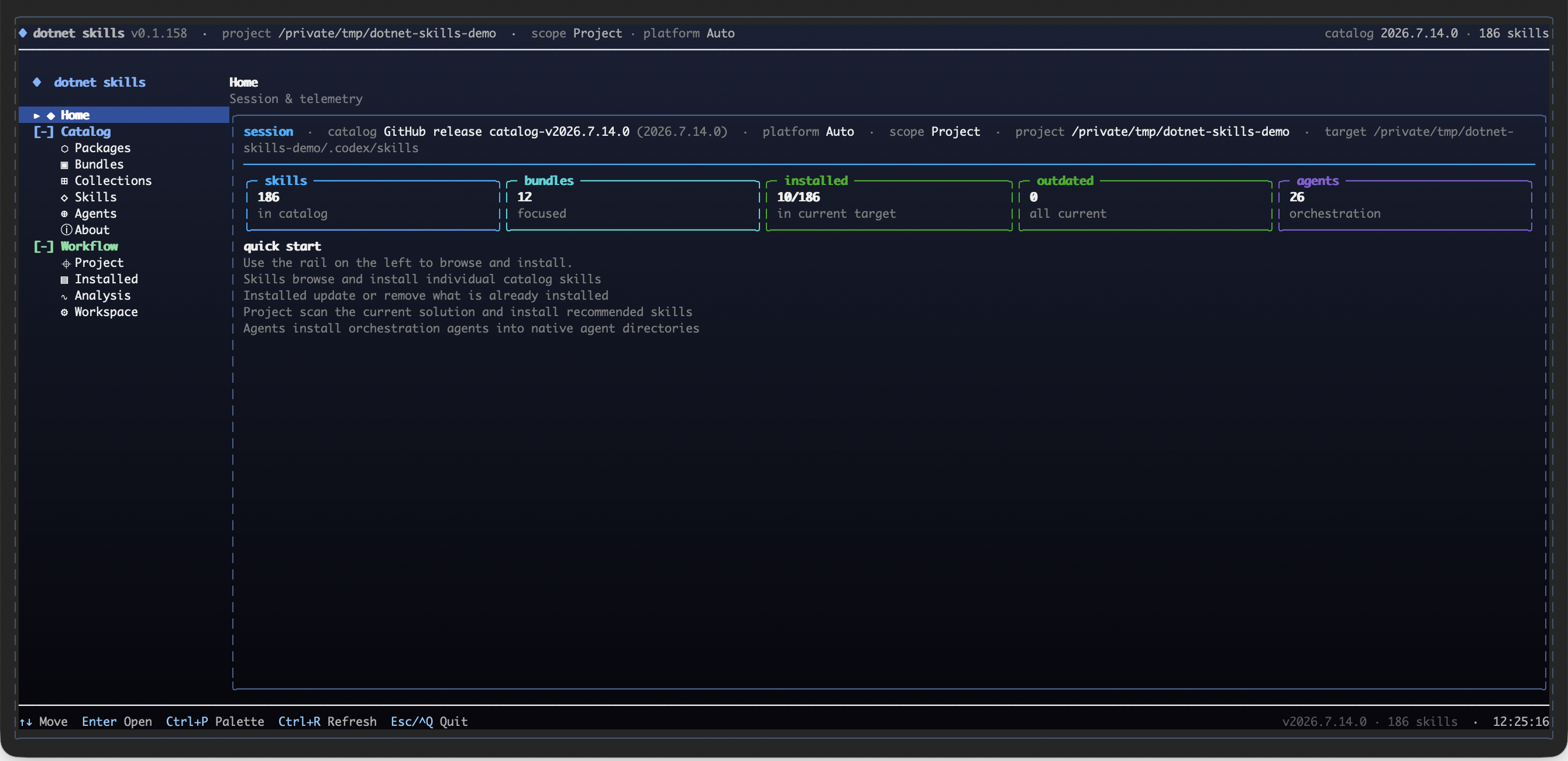
npx skills add managedcode/dotnet-skills --skill entity-framework6The open skills CLI detects your agents (Claude Code, Cursor, Codex and 70+ more) and installs to the right folder. Add -g to install globally.
01
Install it
Run the command above, or upload the folder in Claude.
02
Ask naturally
Describe the task. Your agent loads entity-framework6 when the request matches its description.
03
Name it if needed
If it does not trigger, say “use the entity-framework6 skill”. In Codex, type $entity-framework6.
Entity Framework 6
Trigger On
- working in an EF6 codebase on .NET Framework or modern .NET
- deciding whether to keep EF6, move to modern .NET runtime, or port to EF Core
- reviewing EDMX, code-first, or legacy ASP.NET/WPF/WinForms data access
- planning a data layer migration strategy
Workflow
Audit current EF6 usage before planning any migration. Identify which features the codebase depends on:
// Common EF6-specific patterns to inventory:
// - EDMX designer models (check for *.edmx files)
// - ObjectContext vs DbContext usage
// - Lazy loading with virtual navigation properties
// - Database.SqlQuery<T>() for raw SQL
// - Stored procedure mappings in model
// - Spatial types (DbGeography, DbGeometry)
Decide runtime vs ORM migration separately:
Path When to use Keep EF6 on .NET Framework Legacy app with no runtime pressure EF6 on modern .NET Runtime upgrade needed, ORM migration too risky EF6 → EF Core Clean data layer, no EDMX, minimal stored-procedure mapping For maintenance work — keep EF6 stable:
- use repository + unit of work patterns to isolate data access (see references/patterns.md)
- prefer
DbContextoverObjectContextfor new code - use
AsNoTracking()for read-only queries - configure concurrency tokens with
[ConcurrencyCheck]orIsRowVersion()
For migration work — validate each slice:
- map EF6 features to EF Core equivalents (see references/migration.md)
- migrate one bounded context at a time, not the entire data layer
- run integration tests against the real database provider, not InMemory
- verify:
dotnet ef migrations addsucceeds, queries produce equivalent results, lazy loading behavior matches expectations
Do not promise EF Core features to EF6 codebases — EF6 is stable and supported but not on the innovation path. Keep expectations realistic.
Current Upstream Notes
- The August 2026 EF Core vs EF6 comparison keeps the ORM migration decision separate from runtime modernization. EF6 remains supported but is not actively developed, and it can remain the right ORM when EDMX, ObjectContext, or complex legacy mappings dominate the risk.
- EF Core
v10.0.11servicing does not make EF Core a drop-in replacement or change EF6 guidance by itself; move only when the project has a bounded migration slice and database-backed equivalence tests.
flowchart LR
  A["Audit EF6 usage"] --> B{"EDMX or complex mappings?"}
  B -->|Yes| C["High migration cost — consider keeping EF6"]
  B -->|No| D["Evaluate EF Core migration"]
  D --> E["Migrate one context at a time"]
  E --> F["Integration test against real DB"]
  C --> G["Modernize runtime only"]
  F --> H["Validate query equivalence"]
  G --> H
Deliver
- realistic EF6 maintenance or migration guidance based on actual codebase audit
- clear separation between runtime upgrade and ORM upgrade work
- bounded migration slices with concrete validation checkpoints
- reduced risk for legacy data access changes
Validate
- EF6 feature inventory is complete before migration planning starts
- migration assumptions are backed by real feature usage, not guesses
- EF6-only features (EDMX, spatial types, ObjectContext patterns) are identified early
- integration tests run against the real database provider, not mocks or InMemory
- the proposed path avoids unnecessary churn in stable data access code
References
- references/migration.md - decision framework, migration approaches, EF6-to-EF Core feature mapping, and common pitfalls
- references/patterns.md - repository and unit of work patterns, query optimization, concurrency handling, auditing, and testing strategies for EF6 codebases
Tips for Entity Framework6
- • Start a fresh session after installing so your agent picks up the new skill.
- • It bundles reference files. The agent reads them only when needed, so they cost no context until then.
- • It is part of a pack with 30 skills. Install only the ones you need with --skill to keep triggers precise.
- • If two skills overlap, mention the one you want by name.
Questions about Entity Framework6
What does the Entity Framework6 skill do?
Maintain or migrate EF6-based applications with realistic guidance on what to keep, what to modernize, and when EF Core is or is not the right next step. USE FOR: EF6 codebases; runtime versus ORM migration decisions; EDMX, code-first, ObjectContext, and legacy data-access review. DO NOT USE FOR: unrelated stacks; generic tasks that do not need this specific guidance. INVOKES: inspect the repository context, edit tar
How do I install Entity Framework6?
Run "npx skills add managedcode/dotnet-skills --skill entity-framework6" in your project. The skills CLI installs it for Claude Code, Cursor, Codex and 70+ other agents. In Claude on the web, upload the skill folder as a ZIP under Customize > Skills.
Does Entity Framework6 work in Cursor and Codex?
Yes. Entity Framework6 uses the open SKILL.md format, so it works in Claude Code, Claude, Cursor, OpenAI Codex, Gemini CLI, GitHub Copilot and other agents that support agent skills.
Is Entity Framework6 free?
Entity Framework6 is open source on GitHub under the MIT license. It is free to install; check the license before commercial use.
Who made Entity Framework6?
Entity Framework6 is published by managedcode in the managedcode/dotnet-skills repository, together with 29 other skills.