 elementalsouls
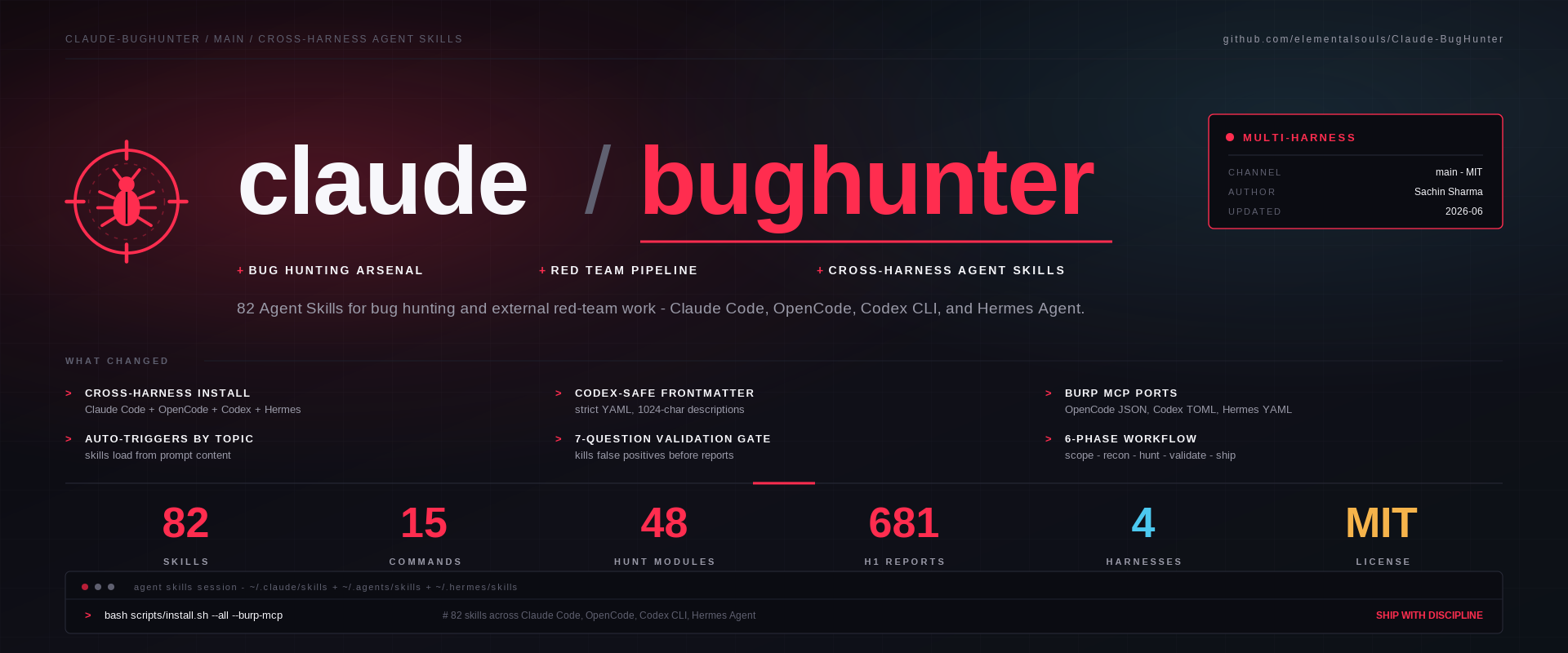
What is the Hunt Aspnet skill?
Hunt Aspnet is a backend skill by elementalsouls for Claude Code, Cursor, Codex and other AI coding agents. Hunt ASP.NET-specific surface — ViewState deserialization (signed-only vs encrypted), machineKey recovery, dual-parser MAC-bypass anti-pattern, request-validator bypass, trace.axd/elmah.axd disclosure, load-balanced ViewState cross-node failures, SafeControl enumeration via reflection, customErrors mode=Off stack-trace leaks, classic Webforms .aspx/.asmx/.svc surface.
ASP.NET deserialization bugs pay among the highest amounts in bug bounty when they reach RCE. Even when patched, the disclosure-tier findings (signed-only ViewState, dual-parser differential, request-validator quirks) reliably pay Low-Medium.
What the SKILL.md covers
- Crown Jewel Targets
- Attack Surface Signals
- Step-by-Step Hunting Methodology
- Payload & Detection Patterns
- Common Root Causes
- Bypass Techniques
- Gate 0 Validation
- Real Impact Examples
- Related Skills & Chains
- Author
- elementalsouls
- Pack
- elementalsouls/Claude-BugHunter (30 skills)
- Category
- Backend, #184 of 317
- Alyn Score
- 64 / 99
- Files
- 1
- License
- MIT
- Last updated
- 35 h ago
- Works with
- Claude Code, Claude, Cursor, Codex, Gemini CLI, Copilot
Hunt Aspnet compared to similar skills
| Skill | Alyn Score | GitHub stars | Updated |
|---|---|---|---|
| Hunt Aspnet · elementalsouls | 64 | 21k | 35 h ago |
| Nodejs Core · mcollina | 66 | 2k | 9 days ago |
| Devcontainer Setup · trailofbits | 77 | 8.4k | 2 days ago |
| Backend Patterns · affaan-m | 91 | 310k | 3 days ago |
Install Hunt Aspnet
Pick your agent. Every command is ready to paste.
npx alyn-cli add hunt-aspnetDetects your agents (Claude Code, Cursor, Codex and 70+ more) and installs to the right folder. Add -g to install globally.
npx skills add elementalsouls/Claude-BugHunter --skill hunt-aspnetOr use the open skills CLI directly.
01
Install it
Run the command above, or upload the folder in Claude.
02
Ask naturally
Describe the task. Your agent loads hunt-aspnet when the request matches its description.
03
Name it if needed
If it does not trigger, say “use the hunt-aspnet skill”. In Codex, type $hunt-aspnet.
Crown Jewel Targets
ASP.NET deserialization bugs pay among the highest amounts in bug bounty when they reach RCE. Even when patched, the disclosure-tier findings (signed-only ViewState, dual-parser differential, request-validator quirks) reliably pay Low-Medium.
Highest-value targets:
- SharePoint farms (any version — 2013/2016/2019/SE) — sign-only ViewState + permissive ToolPane.aspx + anonymous FormDigest creates the CVE-2025-53770 ToolShell precondition chain
- Telerik UI for ASP.NET AJAX —
Telerik.Web.UI.WebResource.axdis a documented RCE sink when keys leak (CVE-2017-11317, CVE-2017-11357, CVE-2019-18935) - Classic ASP.NET Webforms enterprise apps — banking portals, dealer portals, HR systems left on .NET Framework 4.x
- WCF services (
*.svc?WSDL) — often forgotten admin endpoints with looser auth than the main app - Sitecore CMS — ViewState + Sitecore-specific deserialization chains (CVE-2021-42237)
- DotNetNuke (DNN) — historic ViewState RCE chains
- Umbraco CMS — ViewState + custom deserialization sinks
Asset types that pay most: internet-reachable ASP.NET Webforms apps > WCF admin services > Telerik-integrated sites > Classic ASP.NET MVC with VSF (very rare)
Attack Surface Signals
Response headers indicating ASP.NET:
X-AspNet-Version: 4.0.30319          (classic — disclosure on its own)
X-Powered-By: ASP.NET
X-AspNetMvc-Version: 5.2
Server: Microsoft-IIS/10.0
Set-Cookie: ASP.NET_SessionId=...
Set-Cookie: .ASPXAUTH=...            (Forms auth cookie)
Set-Cookie: .ASPXFORMSAUTH=...
Set-Cookie: ASP.NET_SessionId=...; SameSite=None  (suggests cross-origin embedding)
Body signals (in form HTML):
<input type="hidden" name="__VIEWSTATE" id="__VIEWSTATE" value="..." />
<input type="hidden" name="__VIEWSTATEGENERATOR" id="__VIEWSTATEGENERATOR" value="..." />
<input type="hidden" name="__VIEWSTATEENCRYPTED" id="__VIEWSTATEENCRYPTED" value="" />
                                        ↑ EMPTY = signed-only, not encrypted = exploitable if key leaks
<input type="hidden" name="__EVENTVALIDATION" id="__EVENTVALIDATION" value="..." />
<input type="hidden" name="__REQUESTDIGEST" id="__REQUESTDIGEST" value="0x...,...">
                                        ↑ SharePoint CSRF token; if anon-issued, see hunt-sharepoint
URL patterns to probe:
/trace.axd                            (per-app trace viewer; sometimes anon-accessible)
/elmah.axd                            (ELMAH error log viewer)
/elmah.axd/?id=...                    (ELMAH RCE / stack-trace leak)
/*.svc                                (WCF services)
/*.svc?wsdl                           (WCF WSDL)
/*.svc/mex                            (Metadata Exchange)
/*.asmx                               (legacy SOAP)
/*.asmx?WSDL                          (legacy SOAP description)
/*.asmx?disco                         (legacy discovery)
/Telerik.Web.UI.WebResource.axd       (Telerik AJAX components)
/ChartImg.axd                         (DataVisualization controls; historic deserialization)
/ScriptResource.axd                   (script resource handler; sometimes leaks paths)
/WebResource.axd                      (web resource handler)
/_vti_bin/*                           (SharePoint Web Service Forwarder)
/api/                                 (Web API 2.x is ASP.NET on classic framework)
/signin                               (often FedAuth / WS-Federation)
Tech-stack signals:
Server: Microsoft-IIS/10.0(or/8.5,/7.5) — confirmed Windows + IISX-AspNet-Versionheader — classic .NET Framework (4.x); .NET Core/5+ does NOT emit this- Cookies with
ASP.NET_SessionId,.ASPXAUTH,FedAuth— Forms or claims auth __VIEWSTATEin form bodies — Webforms (NOT MVC, NOT Razor Pages, NOT Blazor)MicrosoftSharePointTeamServicesheader (sometimes stripped by ELB but leaks instart.aspxbody) — SharePoint
Step-by-Step Hunting Methodology
Fingerprint the framework version. Trigger any 500 error (stale ViewState POST is a reliable way) and look for
Version Information: Microsoft .NET Framework Version:X.X.XXXXX; ASP.NET Version:X.X.XXXX.Xin the error body. This banner discloses both the runtime and ASP.NET-version-specific patch level. .NET 4.0.30319 + ASP.NET 4.8.x is the most common modern combination.Locate every form with
__VIEWSTATE. Spider the target and grep forname="__VIEWSTATE". Each is a candidate sink for deserialization attacks if MAC / encryption is bypassable.Check
__VIEWSTATEENCRYPTEDvalue. Empty (value="") means ViewState is signed-only via<machineKey>but NOT encrypted. Recovery of the validation key → arbitrary deserialization. Non-empty (value="something") means ViewState is BOTH signed and encrypted; both keys needed to forge.Test the ViewState parser-error differential (the dual-parser anti-pattern). Send 7+ ViewState shapes and classify responses:
- Trivial garbage (
AAAA) →"Validation of viewstate MAC failed" - Real prefix from current page →
"Validation of viewstate MAC failed" - Flipped-bit real ViewState →
"Validation of viewstate MAC failed" - Oversize (
A * 100000) →"Validation of viewstate MAC failed" - XML-shaped (
<xss/>) → "The state information is invalid for this page and might be corrupted" ← different parser path - LosFormatter-style prefix (
/wEPDwUKMTcxNzgyOTQwMmRkkz9p4lzA...) → "The state information is invalid for this page and might be corrupted"
The differential proves there are two distinct deserialization entry points, one of which dispatches BEFORE the MAC check on some payload shapes. Historically this enables MAC-before-parse-bypass exploits.
- Trivial garbage (
Look for load-balanced cross-node ViewState MAC failures. If POST gets a 500 with
"Validation of viewstate MAC failed. If this application is hosted by a Web Farm or cluster, ensure that <machineKey> configuration specifies the same validationKey...", the farm has multiple WFEs WITHOUT machineKey sync, or without sticky-session affinity. Operationally this breaks legit users; security-wise it confirms farm topology.Probe
trace.axdandelmah.axd. If either returns 200 anonymously, it's a Critical finding (trace leaks every request + headers + form data; ELMAH leaks every server error including stack traces).Enumerate WCF services (
.svc). For each, fetch?wsdland?mex(metadata exchange). MEX endpoints sometimes return full service contracts including admin operations.Test request-validator bypass. ASP.NET's request validator blocks
<in query strings by default. Bypass categories that may still get through:- HTML-entity-encoded payloads (
<script>— but these don't execute) - Encoded inside JSON / XML POST bodies (different content-type ≠ same validator)
- In path segments (not query) — validator scope depends on framework version
- In Cookie / Referer headers (varies)
- Inside
<%@ ... %>ASP directives if reached via WebDAV PUT (rare)
- HTML-entity-encoded payloads (
Check
customErrorsmode. If 500s expose full stack traces, framework versions, file paths, internal method names →customErrors mode="Off"is set. Should beRemoteOnlyfor production.Look for Telerik components.
Telerik.Web.UI.WebResource.axd?type=rauis the historic upload-to-RCE chain (CVE-2017-11317). ThedialogParametersHolderparameter chain (CVE-2019-18935) requires the encryption key but is otherwise RCE.SharePoint-specific deserialization paths — see
hunt-sharepointskill for the ToolPane.aspx + anonymous FormDigest + unencrypted ViewState chain.SafeControl enumeration via reflection. SharePoint's
Picker.aspx?PickerDialogType=<TypeName>(and DNN-equivalent endpoints) accept class names and return DIFFERENT error messages for "type exists but not whitelisted" vs "type does not exist." Feed a wordlist ofMicrosoft.SharePoint.*.WebControls.*types to enumerate the SafeControl list — useful for CVE-2019-0604-family hunting.
Payload & Detection Patterns
Stack-trace fingerprint (trigger via stale ViewState POST):
curl -sk -X POST "https://target.example/page.aspx" \
  --data "__VIEWSTATE=AAAA&__VIEWSTATEGENERATOR=AAAA"
# Inspect body for:
#  - "Validation of viewstate MAC failed" → confirms signed ViewState
#  - "The state information is invalid for this page" → confirms ALTERNATE parser path
#  - "Version Information: Microsoft .NET Framework Version:X.X.XXXXX" → exact patch level
#  - "Microsoft.SharePoint.Client.ServerStub..." → SharePoint farm
ViewState parser-error differential probe (Python):
import requests, re, json
S = requests.Session(); S.verify = False
# Get fresh form
r = S.get("https://target.example/path/page.aspx")
real_vs = re.search(r'__VIEWSTATE" id="__VIEWSTATE" value="([^"]+)', r.text).group(1)
real_vsg = re.search(r'__VIEWSTATEGENERATOR" id="__VIEWSTATEGENERATOR" value="([^"]+)', r.text).group(1)

# Test 7 payload shapes
for label, vs in [
    ("trivial",      "AAAA"),
    ("real",         real_vs),
    ("flipped-bit",  real_vs[:50] + "X" + real_vs[51:]),
    ("oversize",     "A" * 100000),
    ("base64",       "VGVzdE1hcmtlcjY3OFhZWg=="),
    ("xml-shaped",   "<xss/>"),
    ("losformatter", "/wEPDwUKMTcxNzgyOTQwMmRkkz9p4lzA" + "A"*50),
]:
    r = S.post("https://target.example/path/page.aspx",
               data={"__VIEWSTATE": vs, "__VIEWSTATEGENERATOR": real_vsg})
    title = re.search(r'<title>([^<]+)</title>', r.text)
    title = title.group(1)[:100] if title else "—"
    print(f"  [{label:14s}] {r.status_code}  {title}")
trace.axd anonymous check:
curl -sk -o /dev/null -w "%{http_code}\n" "https://target.example/trace.axd"
# 200 = full trace dump exposed → Critical
# 403 = mod set to localhost-only → check via X-Forwarded-For: 127.0.0.1
WCF service enumeration:
# Find all .svc files
curl -sk "https://target.example/" -o body.html
grep -oE '/[a-zA-Z0-9/_-]+\.svc' body.html | sort -u
# For each found:
curl -sk "https://target.example/Service.svc?wsdl" | xmllint --format - | head -60
Request-validator bypass categories:
# Default: <script>alert(1)</script> in ?q= → "Potentially dangerous Request.QueryString value detected"
# Bypasses that sometimes work:
?q=%3cscript%3e            (URL-encoded — depends on validator config)
?q=<svg/onload=alert(1)>  (depends on validator version)
?q=<%00script>             (NUL-byte; older validators)
?q=javascript:alert(1)     (no < at all — passes validator)
Cookie: foo=<script>       (cookie body not validated by default)
Referer: http://x.com/<script>  (referer not validated in classic ASP.NET)
Telerik exploit gate (CVE-2019-18935 — requires encryption keys):
# Fingerprint Telerik
curl -sk "https://target.example/Telerik.Web.UI.WebResource.axd?type=rau" -X POST
# If response is RadAsyncUploadHandler-style → Telerik present; try keys
# Public exploits require leaked machineKey AND telerikEncryptionKey
Common Root Causes
viewStateEncryption="Auto"defaults to signed-only on pages without sensitive ViewState data. Many SharePoint pages are configured this way. When__VIEWSTATEENCRYPTEDis empty, ViewState is signed-only — recovery ofvalidationKeyalone enables forgery.<machineKey>AutoGenerate in a Web Farm. Each WFE generates a different key on first boot; ViewState issued by one WFE fails MAC validation on another. Operationally produces 500s; security-wise broadcasts the topology (the error message names the cluster).<customErrors mode="Off">left from development. Stack traces with full method names, file paths, version banners exposed to anonymous internet users.trace.axd/elmah.axdleft enabled in production. Often forgotten in<system.web><trace enabled="true">blocks.Forgotten WCF
.svcadmin endpoints. Built for internal admin tooling, never disabled when the main app went to internet exposure.Dual-parser anti-pattern:
ObjectStateFormatter(legacy) vsLosFormatter(modern) deserialize in different orders relative to MAC validation. Some payload shapes hit the legacy parser BEFORE MAC check.Request validator only applies to URL-encoded body and querystring. Headers, cookies, XML/JSON bodies, and multipart fields are NOT validated by default. Developers assume validator is universal; it is not.
<machineKey>checked into source repos. Configuration check-ins to GitHub frequently leak validation/decryption keys. Combine withhunt-miscsource-recon for Telerik / SharePoint / DNN keys.SafeControlsweb.config entries trusted to gate deserialization. SharePoint's<SafeControl>list determines which classes Picker.aspx can instantiate. Bypasses exist when the inheritance check is the only gate (CVE-2019-0604 family).
Bypass Techniques
| Defense | Bypass |
|---|---|
__VIEWSTATEENCRYPTED non-empty (encrypted) |
Recover both decryption + validation keys from any source-code leak / config-disclosure / VS forge primitive; without keys, deserialization cannot be triggered |
Request validator blocks < in querystring |
Move payload to Cookie / Referer / JSON body / multipart filename — validator doesn't reach those contexts in classic ASP.NET |
EnableViewStateMac="true" enforced |
Recover validationKey from web.config disclosure or <machineKey> AutoGenerate fingerprinting (ysoserial.net --minify --islegacy mode generates ViewState that passes some MAC-validation gaps) |
trace.axd localhost-only |
Set X-Forwarded-For: 127.0.0.1 if the trace mode is localOnly and the validation uses Request.UserHostAddress (some apps use Forwarded-For instead) |
WCF .svc 401 on anonymous |
Try ?wsdl and ?mex first; metadata is sometimes anonymously enumerable even when service ops require auth |
| Telerik upload patched | Check the Telerik version: anything pre-2017Q1 (build 2017.1.118 or earlier) is the original RAU RCE. Check 2017Q3 - 2019Q3 for CVE-2019-18935 |
SafeControl whitelist enforced |
Inheritance gate (instanceof PickerDialog) IS the gate on patched SP — bypass requires finding a SafeControl subclass with a deserialization sink; enumerate via Picker.aspx |
customErrors mode="On" (no stack traces) |
Force a different error path: invalid Content-Length, malformed ViewState that triggers a parser-level exception below the customErrors handler |
Gate 0 Validation
Before writing the report, confirm:
What can the attacker DO right now with the disclosed information?
trace.axd200 with full request dump → Critical (PII / session cookies / Authorization headers exposed)elmah.axd200 with error log → High (stack traces + internal paths + sometimes credentials)__VIEWSTATEENCRYPTEDempty + recoverable machineKey via separate finding → Critical chain to RCE__VIEWSTATEENCRYPTEDempty without key recovery → Low-Medium (primitive present, not exploitable on its own)- Stack traces in 500s → Low unless they include credentials / connection strings
Have you reproduced the full chain to attacker-attainable impact, or only the primitive?
- Cross-reference
triage-validationPre-Severity Gate. "Primitive confirmed" is not Critical until the chain ends in impact.
- Cross-reference
Can a triager reproduce in <10 min from your report?
- Each step copy-pasteable curl / Python.
- For RCE chains: link the public exploit tool (ysoserial.net, viewgen, telerik-revda) and the specific gadget chain.
Real Impact Examples
Scenario A — Signed-only ViewState + permissive ToolPane on EoL SharePoint 2013
https://target-portal.example/_layouts/15/ToolPane.aspx?DisplayMode=Edit returns 200 anonymously. The form contains __VIEWSTATE (signed only — __VIEWSTATEENCRYPTED=""), and __REQUESTDIGEST is anonymously issued via _api/contextinfo. Combined with SP2013 being end-of-life (no patch will ever ship), this is the canonical CVE-2025-53770 "ToolShell" precondition chain on a permanently-unpatched code path. Reported severity: Critical. The dual-parser test (Section 4 of Methodology) confirmed that XML-shaped payloads reach the legacy ObjectStateFormatter BEFORE MAC validation — additional evidence that the chain is reachable even without full machineKey recovery (though full RCE requires both).
Scenario B — Telerik RadAsyncUploadHandler exposed on legacy bank portal
/Telerik.Web.UI.WebResource.axd?type=rau returns the Telerik upload handler. Telerik version (visible in JS bundle metadata) is 2016.3.1027. CVE-2017-11317 applies — keys are baked into the public Telerik DLL of that version. Upload → write aspx to /app_data/ → request → RCE. Reported severity: Critical.
Scenario C — trace.axd + elmah.axd both exposed on enterprise HR portal
trace.axd 200 returns 50 most recent requests, including Authorization: Bearer eyJ... headers on API requests. elmah.axd 200 returns full error log with database connection-string in one of the exceptions. Reported severity: Critical (credentials in plaintext to anonymous internet).
Related Skills & Chains
hunt-rce— ViewState deserialization is the headline ASP.NET RCE path; signed-only ViewState + leaked machineKey = RCE every time. Chain primitive: ASP.NET ViewState dual-parser MAC-bypass anti-pattern detected (signed but not encrypted,<%@ Page enableViewStateMac="true" viewStateEncryptionMode="Never" %>) + machineKey recovered (from web.config disclosure,elmah.axd, source leak, or GitHub) →hunt-rceysoserial.netTypeConfuseDelegategadget → arbitrary command inw3wp.exeworker-process identity.hunt-sharepoint— SharePoint farms inherit every ASP.NET anti-pattern plus their own surface. Chain primitive: ASP.NET fingerprint reveals SharePoint (X-SharePoint headers +/_layouts/reachable) → pivot tohunt-sharepointfor SP-specific RCE paths (ToolShell, SafeControl reflection) before generic ViewState attack.hunt-ntlm-info— IIS sites that advertise NTLM/Negotiate anonymously leak AD topology. Chain primitive: ASP.NET app behind IIS withWWW-Authenticate: NTLM→hunt-ntlm-infoType-2 challenge capture → internal forest name → cross-reference Entra tenant viam365-entra-attackdiscovery.hunt-file-upload— Telerik RadAsyncUpload, Kentico, Umbraco, and DotNetNuke all have historical upload-handler RCE. Chain primitive: ASP.NET CMS fingerprinted →hunt-file-uploadbypass matrix against the CMS upload handler →.aspxwritten into web-accessible path → request → RCE under app-pool identity.triage-validation—trace.axd/elmah.axddisclosure is only Critical when it actually leaks live credentials/tokens; pure stack traces are usually Low. Chain primitive: pull every reported finding throughtriage-validation7-Question Gate before submission — distinguish "verbose error" (informational) from "live bearer token in error log" (Critical) before writing the report (redteam-report-template).
Tips for Hunt Aspnet
- • Start a fresh session after installing so your agent picks up the new skill.
- • It is part of a pack with 30 skills. Install only the ones you need with --skill to keep triggers precise.
- • If two skills overlap, mention the one you want by name.
Questions about Hunt Aspnet
What does the Hunt Aspnet skill do?
Hunt ASP.NET-specific surface — ViewState deserialization (signed-only vs encrypted), machineKey recovery, dual-parser MAC-bypass anti-pattern, request-validator bypass, trace.axd/elmah.axd disclosure, load-balanced ViewState cross-node failures, SafeControl enumeration via reflection, customErrors mode=Off stack-trace leaks, classic Webforms .aspx/.asmx/.svc surface.
How do I install Hunt Aspnet?
Run "npx alyn-cli add hunt-aspnet" in your project. The Alyn CLI installs it for Claude Code, Cursor, Codex and 70+ other agents. In Claude on the web, upload the skill folder as a ZIP under Customize > Skills.
Does Hunt Aspnet work in Cursor and Codex?
Yes. Hunt Aspnet uses the open SKILL.md format, so it works in Claude Code, Claude, Cursor, OpenAI Codex, Gemini CLI, GitHub Copilot and other agents that support agent skills.
What is inside the Hunt Aspnet skill?
The SKILL.md covers Crown Jewel Targets, Attack Surface Signals, Step-by-Step Hunting Methodology, Payload & Detection Patterns, Common Root Causes, Bypass Techniques.
What is a good alternative to Hunt Aspnet?
Nodejs Core by mcollina is the highest-ranked similar skill from another creator, with an Alyn Score of 66 compared to 64 for Hunt Aspnet.
Is Hunt Aspnet free?
Hunt Aspnet is open source on GitHub under the MIT license. It is free to install; check the license before commercial use.
Who made Hunt Aspnet?
Hunt Aspnet is published by elementalsouls in the elementalsouls/Claude-BugHunter repository, together with 29 other skills.


