phuryn
Install Pricing Strategy
Pick your agent. Every command is ready to paste.
npx skills add phuryn/pm-skills --skill pricing-strategyThe open skills CLI detects your agents (Claude Code, Cursor, Codex and 70+ more) and installs to the right folder. Add -g to install globally.
01
Install it
Run the command above, or upload the folder in Claude.
02
Ask naturally
Describe the task. Your agent loads pricing-strategy when the request matches its description.
03
Name it if needed
If it does not trigger, say “use the pricing-strategy skill”. In Codex, type $pricing-strategy.
Pricing Strategy
Design a pricing strategy grounded in value delivery, competitive positioning, and willingness to pay.
Context
You are developing a pricing strategy for $ARGUMENTS.
If the user provides files (competitor pricing, survey data, financial models, or usage data), read them first. Use web search to research competitor pricing if needed.
Instructions
Understand the value delivered:
- What is the core value proposition?
- What is the customer's alternative (and its cost)?
- What quantifiable outcomes does the product deliver? (time saved, revenue gained, cost reduced)
- What is the customer's willingness to pay based on that value?
Evaluate pricing models — recommend the best fit:
Model Best For Example Flat-rate Simple products, predictable costs Basecamp ($99/mo flat) Per-seat Collaboration tools, team products Slack, Figma Usage-based Infrastructure, API products AWS, Twilio Tiered Products with distinct user segments Most SaaS (Free/Pro/Enterprise) Freemium Products with viral/network effects Spotify, Notion Freemium + usage Platform products Vercel, OpenAI API Value-based High-impact enterprise tools Salesforce, Palantir Analyze competitive pricing:
- Map competitor pricing tiers and what's included
- Identify where your product sits (premium, mid-market, budget)
- Find pricing gaps or opportunities
- Note any industry pricing conventions
Design the pricing structure:
- Tiers: Define 2-4 tiers with clear differentiation
- Feature gating: Which features go in which tier? (Use value metrics, not arbitrary limits)
- Value metric: What unit do you charge on? (users, events, storage, API calls)
- Anchor pricing: Set the most popular tier to feel like the obvious choice
- Annual discount: Typically 15-20% off monthly pricing
Estimate price sensitivity:
- Van Westendorp Price Sensitivity Meter (if survey data available):
- Too cheap → quality concerns
- Cheap → good value
- Expensive → starting to hesitate
- Too expensive → won't buy
- Alternatively, estimate based on competitor pricing and value delivered
- Van Westendorp Price Sensitivity Meter (if survey data available):
Plan pricing experiments:
- A/B test pricing pages (different price points, tier names, feature bundles)
- Founder-led sales conversations to test willingness to pay
- Landing page tests with different price anchors
- Cohort analysis of conversion rates by price point
Output a pricing recommendation:
Recommended Model: [Model type]
Value Metric: [What you charge on]

| Tier | Price | Target Segment | Key Features | Positioning |
|---|---|---|---|---|

Key Assumptions:
- [Assumption] → [How to test]

Risks:
- [Risk] → [Mitigation]
Think step by step. Save as markdown. Flag any assumptions that need validation before launch.
Further Reading
Tips for Pricing Strategy
- • Start a fresh session after installing so your agent picks up the new skill.
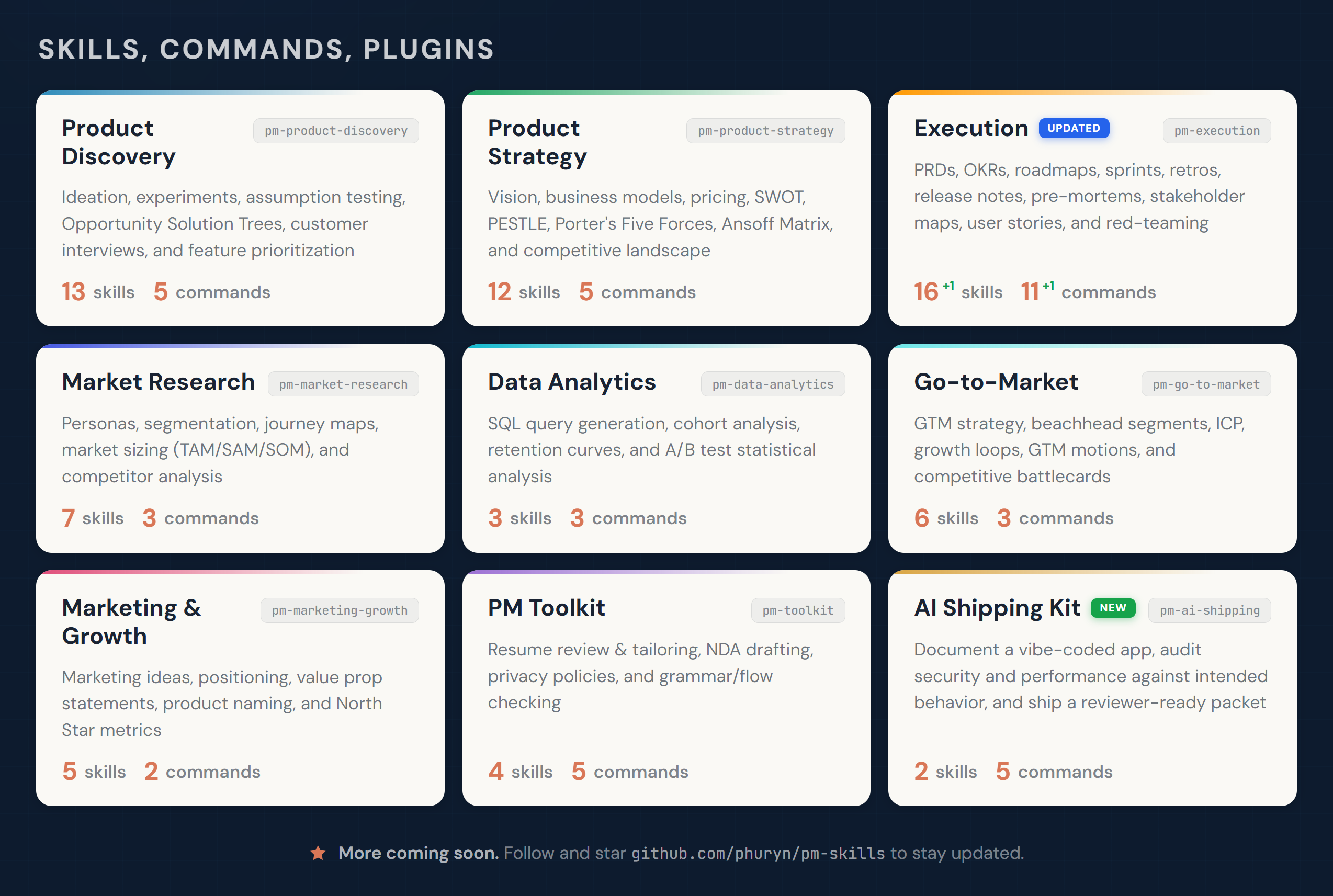
- • It is part of a pack with 72 skills. Install only the ones you need with --skill to keep triggers precise.
- • If two skills overlap, mention the one you want by name.
Questions about Pricing Strategy
What does the Pricing Strategy skill do?
Analyze and design pricing strategies including pricing models, competitive pricing analysis, willingness-to-pay estimation, and price elasticity. Use when setting prices, evaluating pricing models, preparing for a pricing change, or comparing freemium vs paid approaches.
How do I install Pricing Strategy?
Run "npx skills add phuryn/pm-skills --skill pricing-strategy" in your project. The skills CLI installs it for Claude Code, Cursor, Codex and 70+ other agents. In Claude on the web, upload the skill folder as a ZIP under Customize > Skills.
Does Pricing Strategy work in Cursor and Codex?
Yes. Pricing Strategy uses the open SKILL.md format, so it works in Claude Code, Claude, Cursor, OpenAI Codex, Gemini CLI, GitHub Copilot and other agents that support agent skills.
Is Pricing Strategy free?
Pricing Strategy is open source on GitHub under the MIT license. It is free to install; check the license before commercial use.
Who made Pricing Strategy?
Pricing Strategy is published by phuryn in the phuryn/pm-skills repository, together with 71 other skills.