 phuryn
Install Growth Loops
Pick your agent. Every command is ready to paste.
npx skills add phuryn/pm-skills --skill growth-loopsThe open skills CLI detects your agents (Claude Code, Cursor, Codex and 70+ more) and installs to the right folder. Add -g to install globally.
01
Install it
Run the command above, or upload the folder in Claude.
02
Ask naturally
Describe the task. Your agent loads growth-loops when the request matches its description.
03
Name it if needed
If it does not trigger, say “use the growth-loops skill”. In Codex, type $growth-loops.
The skill itself
SKILL.md
Growth Loops
Overview
Identify and design growth loops (flywheels) that create sustainable traction. This skill evaluates five proven growth loop mechanisms to reduce reliance on paid acquisition and build product-led growth.
When to Use
- Designing growth mechanisms for a product
- Building sustainable viral or referral traction
- Reducing reliance on paid acquisition
- Analyzing competitor growth strategies
- Optimizing product for product-led growth
The 5 Growth Loop Types
1. Viral Loop
Product content created by users gets shared on external platforms, bringing new users back to the product.
- Mechanism: Users create content in-product → Share on social/external platforms → New users discover and signup
- Example: Figma designs shared as links, Loom videos shared in emails
- Strength: Exponential user acquisition if content is inherently shareable
- Challenge: Requires highly shareable output and strong incentive to share
2. Usage Loop
Users create content or value within the product, then share it, which invites new users or drives re-engagement.
- Mechanism: User creates → Shares creation → Others consume → Become engaged users
- Example: Twitter threads, Medium articles, Notion templates shared publicly
- Strength: Growth tied directly to product usage and network effects
- Challenge: Requires content creation friction to be very low
3. Collaboration Loop
Users invite colleagues to co-create or collaborate within the product, expanding the user base within organizations.
- Mechanism: User creates → Invites colleagues for collaboration → Colleagues discover product value
- Example: Google Docs invitations, Figma team projects, Slack channels
- Strength: Deep organizational penetration and high retention
- Challenge: Works best for collaborative/team-based products
4. User-Generated Loop
Users discover new content or features through other users' creations, then create and share their own content.
- Mechanism: User discovers content → Creates similar content → Shares creation → Others discover
- Example: TikTok, Pinterest, YouTube trends driving creator participation
- Strength: Creates content flywheel and network effects
- Challenge: Requires critical mass of quality content to sustain
5. Referral Loop
Users invite other potential users in exchange for rewards, incentives, or social recognition.
- Mechanism: User refers → Referred user joins → Referrer gets reward → Shares more referrals
- Example: Dropbox referral bonus, Uber rider referrals, PayPal signup bonuses
- Strength: Directly incentivizes acquisition; easy to measure ROI
- Challenge: Requires valuable incentive without eroding unit economics
How It Works
Step 1: Define Product Value
Clarify the core value users experience:
- Primary action users take in your product
- Value created per user action
- Network effects present (if any)
- Friction points in the experience
Step 2: Evaluate Loop Fit
Assess which growth loops align with your product:
- Product type (collaborative, content-based, utility, etc.)
- Target user behavior and sharing habits
- Network effects already present
- Existing user base and engagement
Step 3: Design Loop Mechanics
Create specific loop implementation:
- Trigger that initiates sharing or invitations
- Incentive for participation (intrinsic or extrinsic)
- Ease of sharing mechanism
- Conversion rate from invite to activation
- Frequency of loop repetition per user
Step 4: Calculate Loop Coefficient
Estimate growth velocity:
- Invites/shares per user per cycle
- Conversion rate of invites to new users
- Net new users per cycle
- Time per cycle iteration
Step 5: Build the Loop
Implement the highest-leverage loop first:
- Start with the most natural loop for your product
- Optimize messaging and friction
- Measure loop metrics and conversion rates
- Compound results over time
Input Format
Use $ARGUMENTS to pass:
- Product description and primary user action
- Target user demographics and behavior
- Existing sharing/collaboration features
- Current growth channels and metrics
- Constraints or opportunities
Output
A growth loops analysis including:
- Ranked evaluation of all 5 loop types for your product
- Recommended primary growth loop with implementation plan
- Secondary loops to layer over time
- Key metrics and measurement framework
- 30-60-90 day implementation roadmap
- Potential loop coefficient and growth projections
Framework
Based on growth loops research by Ognjen Bošković. Focuses on compounding user acquisition through built-in, product-native sharing and collaboration mechanisms.
Tips
- Start with one loop and master it before adding complexity
- Viral loops compound fastest but take time to build
- Collaboration loops create strongest retention and LTV
- Measure loop health weekly during optimization phase
- Combine loops for multiplicative effect once operating at scale
Further Reading
Tips for Growth Loops
- • Start a fresh session after installing so your agent picks up the new skill.
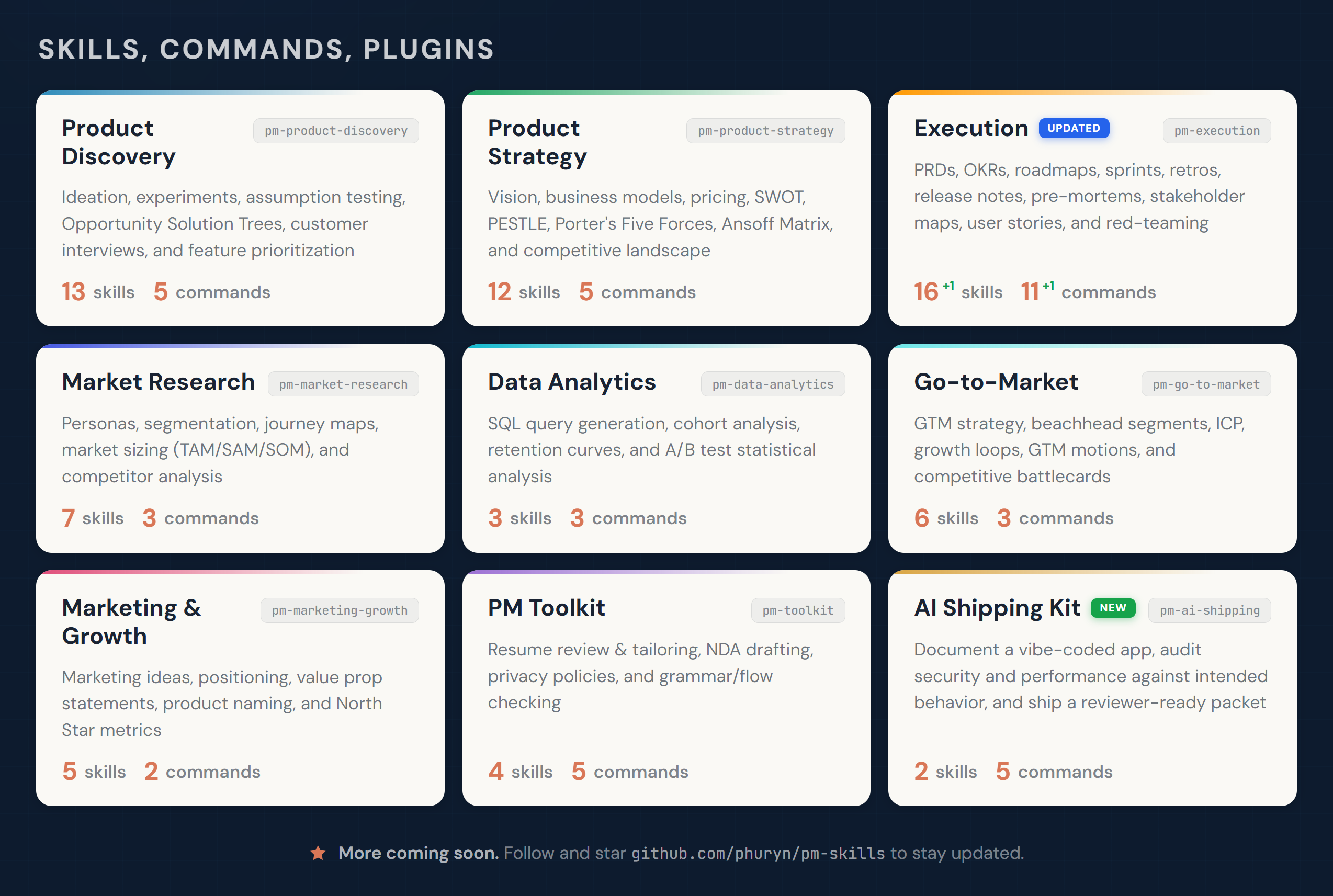
- • It is part of a pack with 40 skills. Install only the ones you need with --skill to keep triggers precise.
- • If two skills overlap, mention the one you want by name.
Questions about Growth Loops
What does the Growth Loops skill do?
Identify growth loops (flywheels) for sustainable traction. Evaluates 5 loop types: Viral, Usage, Collaboration, User-Generated, and Referral. Use when designing growth mechanisms, building product-led traction, or understanding how growth loops work.
How do I install Growth Loops?
Run "npx skills add phuryn/pm-skills --skill growth-loops" in your project. The skills CLI installs it for Claude Code, Cursor, Codex and 70+ other agents. In Claude on the web, upload the skill folder as a ZIP under Customize > Skills.
Does Growth Loops work in Cursor and Codex?
Yes. Growth Loops uses the open SKILL.md format, so it works in Claude Code, Claude, Cursor, OpenAI Codex, Gemini CLI, GitHub Copilot and other agents that support agent skills.
Is Growth Loops free?
Growth Loops is open source on GitHub under the MIT license. It is free to install; check the license before commercial use.
Who made Growth Loops?
Growth Loops is published by phuryn in the phuryn/pm-skills repository, together with 39 other skills.



