Jakeschincariol
Install Li Audit
Pick your agent. Every command is ready to paste.
npx skills add Jakeschincariol/linkedin-agent-skill --skill li-auditThe open skills CLI detects your agents (Claude Code, Cursor, Codex and 70+ more) and installs to the right folder. Add -g to install globally.
01
Install it
Run the command above, or upload the folder in Claude.
02
Ask naturally
Describe the task. Your agent loads li-audit when the request matches its description.
03
Name it if needed
If it does not trigger, say “use the li-audit skill”. In Codex, type $li-audit.
li-audit
The only honest source of what works for an account is that account. Every rule in every LinkedIn guide, including the ones in this pack, is a prior. The user's own last 30 posts are the evidence.
Input
Ask for whichever the user has:
- The post analytics export (LinkedIn: Analytics -> Content -> Export). CSV.
- Or a screenshot per post with impressions, reactions, comments, reposts.
- Or just the posts and their reaction counts, which is enough for a first pass.
Also read ~/.claude/linkedin/log.md if it exists, since it records which
hook formula each post used.
What to actually measure
Raw impressions are the least useful number on the page, because they are mostly a function of how many people already follow the user. Compute these instead, and show the working:
| metric | how | what it tells you |
|---|---|---|
| Engagement rate | (reactions + comments + reposts) / impressions | whether the post earned its reach |
| Comment ratio | comments / reactions | whether it started something or just got a nod |
| Reach multiple | impressions / follower count | whether it travelled past the existing audience |
| Save/send rate | if available | the strongest single predictor of future reach |
Rank by engagement rate and reach multiple, not impressions. A post with 900 impressions and 40 comments beat the one with 12,000 impressions and 6.
Then find the pattern
With the top 5 and bottom 5 side by side, look for what actually separates them, and be willing to conclude something the user will not like:
- Hook formula. Which numbers from
hooks.jsonare in the top 5? - Format. Text, document, image, video.
- Length.
- Theme.
- Day and time - check this last, and only if the other four show nothing. It is almost never the cause, and it is where people want it to be.
- First-hour comments. Posts the user replied to inside an hour versus not.
State the finding as a claim with the evidence attached, and say how confident it is. With 30 posts you can see a pattern; with 6 you cannot, and you should say that instead of inventing one.
Output
AUDIT  ·  31 posts  ·  Jun 12 - Sep 5

TOP 5 BY ENGAGEMENT RATE
  8.1%  #3  Mistake      "$18,000 is what no contract cost me"      1,940 imp
  6.4%  #20 Walk-Away    "I fired my highest-paying client"         2,210 imp
  ...

BOTTOM 5
  0.4%  #5  List         "7 tools every founder needs"             11,400 imp
  ...

WHAT THE DATA SAYS
1. Posts where you were the one who looked bad: mean 6.2% vs 1.1% for
   everything else. n=6. This is your strongest signal and it is not close.
2. Tool listicles get impressions and nothing else. High reach, no comments,
   no leads. Three of your bottom five.
3. Day of week shows nothing. Your Tuesday mean and your Friday mean are
   inside the noise. Stop optimising it.

STOP: listicles about tools.
DO MORE: the ones with a cost you paid, and a number.
Then hand the conclusions to /li-plan so next week's plan is built on the
user's own evidence rather than on defaults.
Tips for Li Audit
- • Start a fresh session after installing so your agent picks up the new skill.
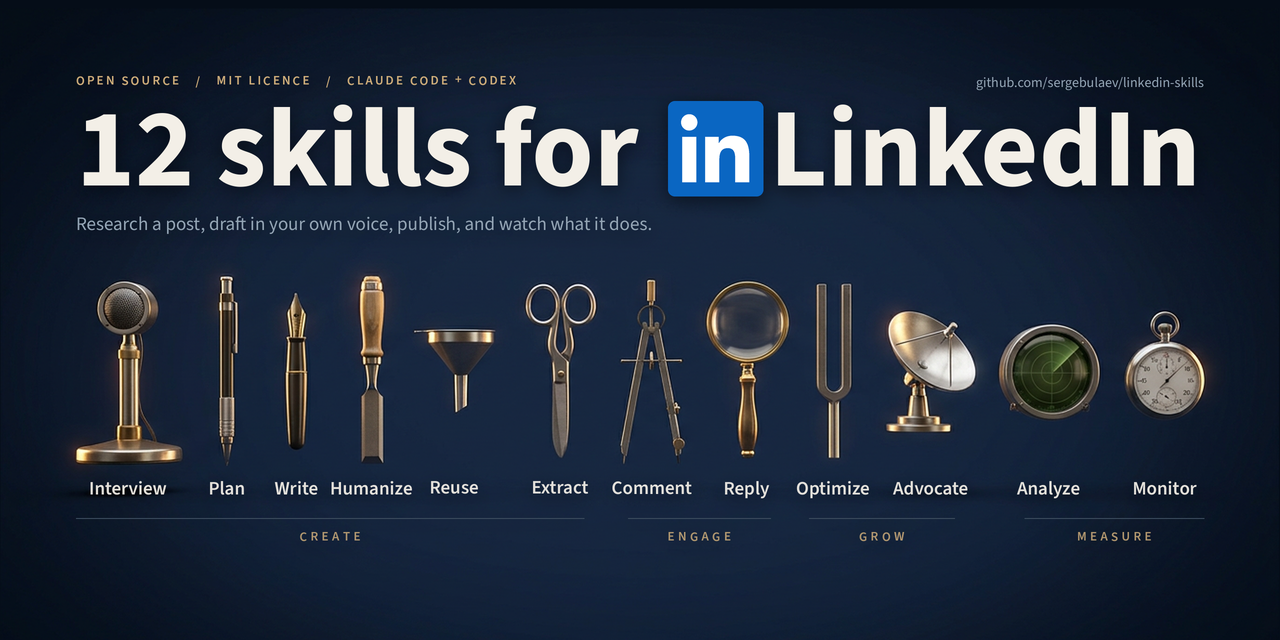
- • It is part of a pack with 11 skills. Install only the ones you need with --skill to keep triggers precise.
- • If two skills overlap, mention the one you want by name.
Questions about Li Audit
What does the Li Audit skill do?
Post-mortem on what the user has already published - which posts actually worked, why, and what to stop doing. Use when the user pastes their LinkedIn analytics or past posts and asks "what's working", "why did this flop", "read my analytics", "audit my content", or wants to know what to double down on.
How do I install Li Audit?
Run "npx skills add Jakeschincariol/linkedin-agent-skill --skill li-audit" in your project. The skills CLI installs it for Claude Code, Cursor, Codex and 70+ other agents. In Claude on the web, upload the skill folder as a ZIP under Customize > Skills.
Does Li Audit work in Cursor and Codex?
Yes. Li Audit uses the open SKILL.md format, so it works in Claude Code, Claude, Cursor, OpenAI Codex, Gemini CLI, GitHub Copilot and other agents that support agent skills.
Is Li Audit free?
Li Audit is open source on GitHub under the MIT license. It is free to install; check the license before commercial use.
Who made Li Audit?
Li Audit is published by Jakeschincariol in the Jakeschincariol/linkedin-agent-skill repository, together with 10 other skills.