sergebulaev
Install Linkedin Content Planner
Pick your agent. Every command is ready to paste.
npx skills add sergebulaev/linkedin-skills --skill linkedin-content-plannerThe open skills CLI detects your agents (Claude Code, Cursor, Codex and 70+ more) and installs to the right folder. Add -g to install globally.
01
Install it
Run the command above, or upload the folder in Claude.
02
Ask naturally
Describe the task. Your agent loads linkedin-content-planner when the request matches its description.
03
Name it if needed
If it does not trigger, say “use the linkedin-content-planner skill”. In Codex, type $linkedin-content-planner.
LinkedIn Content Planner
Produce a 7-day LinkedIn plan built around the 3-pillar discipline (Authority 40-50%, Personal Narrative 30-40%, Community 20-30%). Optionally adds a Product/Offer pillar at 10-15%.
When to use
- User asks "plan my week" or "what should I post this week"
- User wants to escape ad-hoc shipping and establish rhythm
- Before a launch week (user needs product-pillar alignment)
Input
- Theme (optional): e.g., "AI agents shipping in production", "first 6 months of Co.Actor"
- Audience description: e.g., "B2B founders, AI ops leaders, marketing VPs"
- Pillar mix (optional): defaults to 40% Authority / 30% Narrative / 20% Community / 10% Product
- Posting days (optional): defaults to Tue/Wed/Thu/Fri (4 posts)
- Voice samples (optional): only if
../../references/voice-profile.mdis not filled yet
Output
A markdown plan with:
7-day calendar
| Day | Time | Pillar | Format | Hook formula | 1-line angle | CTA type | Goal |
|---|---|---|---|---|---|---|---|
| Mon | — | (commenting day) | — | — | — | — | — |
| Tue | 8:00 AM local | Authority | Text | F7 Odd-Precision Money | "What 3 months of agent ops costs" | Question close | Saves |
| Wed | 9:30 AM local | Narrative | Text | F4 Time-Anchor Confession | "Why I stopped publishing for 4 weeks" | Mirror question | Comments |
| Thu | 8:00 AM local | Community | Text | F14 Named Gratitude | "The 3 people who shaped our launch" | Tag + thanks | Reposts |
| Fri | 9:00 AM local | Narrative | Text | F11 Emotional Cold-Open | "The night our first deploy failed" | Soft close | Likes |
| Sat/Sun | — | (off) | — | — | — | — | — |
The Goal column spans saves / comments / reposts / likes across the four posts, satisfying the Goal mix check below.
Daily comment targets
For each posting day:
- 3-5 creators to engage (names or archetypes: "peer founders at 5-20k", "VCs with AI thesis", "BigCo CTOs")
- Comment pattern to apply (first-commenter, data-first, answer-their-question)
- Target count: 10-20 substantive comments per day
Weekly inbound-readiness check
- At least 1 vulnerability post (Narrative)
- At least 1 receipt/data post (Authority)
- At least 1 soft offer or CTA-driving post
- Comment strategy includes 70% peers, 20% aspirational, 10% prospects
- No pillar >60% of the week's posts
- No duplicate formula used twice in the same week
- Goal mix spread: not every post chases the same reaction (see Goal mix below)
Rules
- 3 pillars minimum, 5 maximum. More than 5 dilutes signal.
- 3-5 posts per week. 6+/week triggers cannibalization signal in 360Brew.
- 10-20 comments/day on other creators. Comments drive more inbound than posts.
- Tue/Wed/Thu top for B2B. Avoid Fri after 2 PM, Sat/Sun (B2B 30-50% reach cut).
- One format per pillar per week. Don't stack 3 text posts for Authority — vary.
- Product/Offer pillar max 1 post/week. Overuse kills trust.
Formula → pillar mapping
| Pillar | Preferred formulas |
|---|---|
| Authority | F7 Odd-Precision Money, F10 Contrarian Historical, F8 Paid-vs-Free, F5 Self-Proving Meta, F15 Explain-to-Kids |
| Narrative | F4 Time-Anchor Confession, F3 Year-over-Year Pivot, F9 Curiosity-Gap, F11 Emotional Cold-Open, F16 Status-Strip |
| Community | F6 Comment-Gate (use sparingly), F12 Permission Slip, F14 Named Gratitude, poll posts, spotlight mentions |
| Product/Offer | F2 R.I.P. Obituary (when pivoting category), F1 Anaphora (when framing product as fix), F13 Bait-and-Switch (upgrade announcements) |
Founders edition (alternative pillar set)
When the whole plan is for a founder building trust with investors, hires, and design partners, swap the default pillar mix for the founder set from ../../references/founder-topics.md. It maps each pillar to founder angles (A1-A10) instead of generic topics, and leans on the structural formulas F17-F20.
| Pillar | Share | Founder angles | Preferred formulas |
|---|---|---|---|
| Conviction (POV, category, product philosophy) | 30-40% | A1 Reprice, A7 Designed Serendipity, A8 Evasive-Sentence | F10, F18, F5 |
| Building in public (the real, unglamorous work) | 30-40% | A5 Unglamorous Bet, A6 Limit of Delegation, A9 Delegation Line | F7, F4, F17 |
| The math (how a founder actually decides) | 15-20% | A4 Scarce-Shots, A10 Learning Gate | F10, F18, F20 |
| Proof (relationships and wins, told narrowly) | 10-15% | A2 Content-to-Pipeline, A3 Audience of One | F9, F11, F5 |
Same guardrails apply: 3-5 posts/week, no pillar above 60%, no formula repeated inside 7 days, spread the goal across the week. Ask the user "founder plan or general plan?" when the audience is a founder building a company, and default to this set if they say founder.
Goal mix (balance the week, not just the pillars)
Every formula earns a primary reaction: comments, reposts, likes, or saves (see ../../references/hook-formulas.md "Engagement-goal split"). A week that is all comment-bait or all repost-bait reads as engineered and flattens reach. Spread the goals across the week:
| Goal | Formulas | Weekly target |
|---|---|---|
| Comments | F4, F10, F12, F9 | at least 1 |
| Reposts | F14, F2, F8 | at least 1 |
| Likes | F11, F13, F16 | at least 1 |
| Saves | F15, F7, F8 | at least 1 |
Steps
Story bank first. If ../../references/story-bank.md has filled: yes, load it before planning anything. The week's angles come from material that already exists: a dated turning point, a number with a named referent, a position the user holds and pays for. Planning a week against an empty bank is how a calendar fills with themes no draft can execute, so if the bank is not filled, say once that linkedin-interviewer fills it in 20 to 40 minutes, then plan from the theme the user gave.
Voice profile. If ../../references/voice-profile.md has filled: yes, load it and respect the CTA and link style it records when picking CTA types. If it is not filled, mention once that linkedin-humanizer --mode profile can learn it from a few posts, then use the generic voice rules.
- Gather inputs. Ask user for theme, audience, pillar preferences if not provided.
- Validate pillar mix sums to 100%; warn if any pillar >60%.
- For each posting day, pick:
- Pillar (rotate to match mix)
- Formula from that pillar's bank (don't repeat within 7 days)
- Format (alternating text / carousel / poll per pillar rules)
- Specific angle, taken from the Story Bank where it has material that fits (name the bank section in the plan so the draft knows what to open), otherwise from the user, otherwise generated. Never put a figure in an angle that is not in the bank or supplied by the user.
- Posting time (audience-timezone aware)
- For each posting day, add 3-5 comment targets with suggested pattern.
- Run inbound-readiness check; flag anything missing.
- Return as markdown + optional JSON for Notion/Airtable import.
Example
See references/example-plan-week.md for a filled-in 7-day plan.
Files
SKILL.md— this filereferences/example-plan-week.md— worked examplereferences/pillars-framework.md— the 3-pillar discipline explained../../references/founder-topics.md— founders-edition angle library (A1-A10) and founder pillar set../../references/story-bank.md— the material the week's angles are drawn from../../references/voice-profile.md— voice fingerprint and CTA style
Related skills
linkedin-interviewer— fills the Story Bank the plan draws its angles fromlinkedin-post-writer— generate each day's draft from the planlinkedin-comment-drafter— execute the daily comment targetslinkedin-thread-monitor— track inbound from the comment strategylinkedin-engager-analytics— segment audience on each post
Tips for Linkedin Content Planner
- • Start a fresh session after installing so your agent picks up the new skill.
- • It bundles reference files. The agent reads them only when needed, so they cost no context until then.
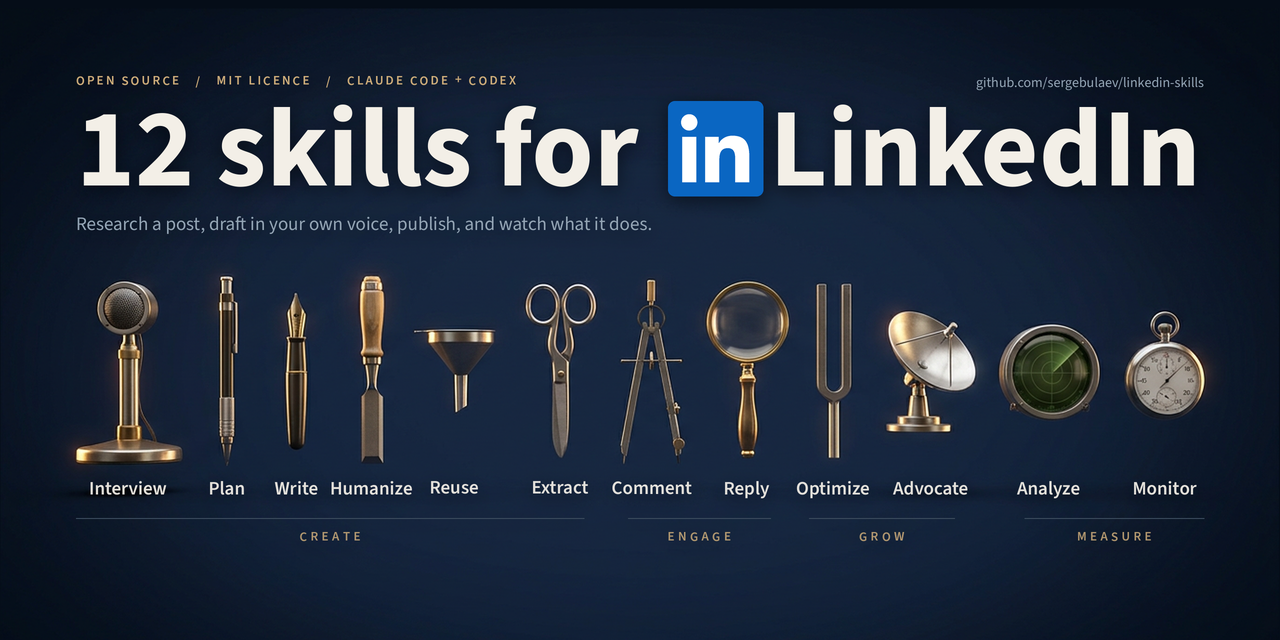
- • It is part of a pack with 13 skills. Install only the ones you need with --skill to keep triggers precise.
- • If two skills overlap, mention the one you want by name.
Questions about Linkedin Content Planner
What does the Linkedin Content Planner skill do?
Generate a 7-day LinkedIn content plan from a theme, audience, and pillars. Produces per-day post pillar, format, hook type, CTA, posting time, daily comment targets, and a weekly inbound-readiness check. Use when the user wants to plan a week or month of content, not draft a single post (use linkedin-post-writer).
How do I install Linkedin Content Planner?
Run "npx skills add sergebulaev/linkedin-skills --skill linkedin-content-planner" in your project. The skills CLI installs it for Claude Code, Cursor, Codex and 70+ other agents. In Claude on the web, upload the skill folder as a ZIP under Customize > Skills.
Does Linkedin Content Planner work in Cursor and Codex?
Yes. Linkedin Content Planner uses the open SKILL.md format, so it works in Claude Code, Claude, Cursor, OpenAI Codex, Gemini CLI, GitHub Copilot and other agents that support agent skills.
Is Linkedin Content Planner free?
Linkedin Content Planner is open source on GitHub under the MIT license. It is free to install; check the license before commercial use.
Who made Linkedin Content Planner?
Linkedin Content Planner is published by sergebulaev in the sergebulaev/linkedin-skills repository, together with 12 other skills.