sergebulaev
Install Linkedin Employee Advocacy
Pick your agent. Every command is ready to paste.
npx skills add sergebulaev/linkedin-skills --skill linkedin-employee-advocacyThe open skills CLI detects your agents (Claude Code, Cursor, Codex and 70+ more) and installs to the right folder. Add -g to install globally.
01
Install it
Run the command above, or upload the folder in Claude.
02
Ask naturally
Describe the task. Your agent loads linkedin-employee-advocacy when the request matches its description.
03
Name it if needed
If it does not trigger, say “use the linkedin-employee-advocacy skill”. In Codex, type $linkedin-employee-advocacy.
LinkedIn Employee Advocacy
Stand up a marketing-team LinkedIn advocacy program that scales without killing authenticity. Employee posts get 8x more engagement than brand-page posts — this skill operationalizes that advantage.
When to use
- Marketing leader wants to get their team posting on LinkedIn
- User is planning an advocacy program launch
- Team is posting but output is inconsistent / off-brand / low-engagement
- Need ROI measurement framework for an existing program
- Requests: "how do I get the team posting", "launch advocacy", "scale LinkedIn across 10 people"
Input
- Team size (5-50 typical)
- Marketing goal (reach / pipeline / recruiting / thought leadership)
- Current state (everyone silent / some active / inconsistent)
- Brand guideline constraints
Output
- 14-day launch plan (if cold-starting)
- Operating model (voice capture, ideation, approval, posting, measurement)
- Cadence targets per team member (realistic, not punishing)
- KPI dashboard spec (team reach, engagement, pipeline attribution)
- Governance playbook (brand safety without blocking velocity)
Four operating principles
- Scale authentically. Individuals compose in their own voice, not corporate language. Corporate-tone team posts underperform authentic voice 3x.
- Maintain control. Brand guidelines integrated into the workflow. Review step is optional, not blocking — high-trust roles bypass review entirely.
- Remove friction. Per-post time budget: 5 minutes. Anything more and the program dies in week 3.
- Prove ROI. Track team reach, engagement, pipeline impact. Without attribution, the program gets cut at the first budget review.
Benchmarks
- Launch target: team posting within 14 days
- Active team size benchmark: 8-11 members
- Output benchmark: 70+ posts/week (at 8 members) or 3-5 posts/member/week
- Per-post time budget: 5 minutes
- Team touchpoint math: 11 people × 3 posts/week × 300 min impressions = 40,000 monthly touchpoints baseline
- Employee vs. brand page: 8x more engagement, 6-8x more reach on personal posts
14-day launch playbook
Days 1-3: Voice capture
- Short interview with each team member (5-10 min) to extract their actual voice
- Identify their domain expertise and 2-3 content pillars
- Set realistic individual cadence (some commit to 1/week, some 3/week — don't force uniformity)
Days 4-7: First posts
- Everyone ships their first post, drafted in their voice
- Marketing reviews only for brand safety (never for style)
- Celebrate every first post internally — social proof unlocks the next team member
Days 8-10: Ideation pipeline
- Set up a shared ideation source (newsletter digest, trending-topics feed, internal wins)
- Each team member gets 5-10 topic suggestions per week
- They pick, not assigned
Days 11-14: Rhythm lock
- Establish cadence: each team member publishes on fixed days/times
- Set up KPI dashboard (see below)
- Run first weekly review
Governance: brand-safe without being blocked
What marketing reviews:
- Factual claims about the company / products / customers
- Confidential info
- Legal/compliance issues (finance, health, regulated industries)
What marketing does NOT review:
- Personal voice, tone, style
- Opinions the team member has about their own work
- Formatting, hashtags, emoji choices
- Topic selection (within pillars)
The review SLA: <4 business hours. Anything longer and the post is dead (posts go stale in the news cycle).
ROI measurement
Per-person metrics (content quality)
- Impressions per post
- Engagement rate (reactions + comments + shares / impressions)
- Comments (depth signal)
- Profile views attributed to post
Team-level metrics (program health)
- Total team reach
- Total team engagement
- Individual contribution rank (leaderboard)
- Active members / total members (participation rate)
Business metrics (pipeline impact)
- Inbound DMs sourced from LinkedIn content
- Meetings booked from LinkedIn
- Closed-won deals with LinkedIn as first-touch channel
- Employee referrals sourced from LinkedIn (if recruiting is a goal)
Anti-patterns
- Copy-paste corporate posts across team accounts — LinkedIn detects this, suppresses all of them
- Ghostwriting that erases the writer's voice — reads as fake
- Mandatory posting cadence without individual calibration — program dies in 6 weeks
- Approval loops >24h — makes the program feel like work
- Measuring only vanity metrics — program gets cut without pipeline attribution
- All-same pillars across team — redundancy kills team reach (360Brew penalizes clustering)
Resources
references/advocacy-principles.md— the 4 operating principles with examplesreferences/team-cadence-matrix.md— realistic cadence by role + seniorityreferences/governance-playbook.md— what to review, what not to, SLA
Related skills
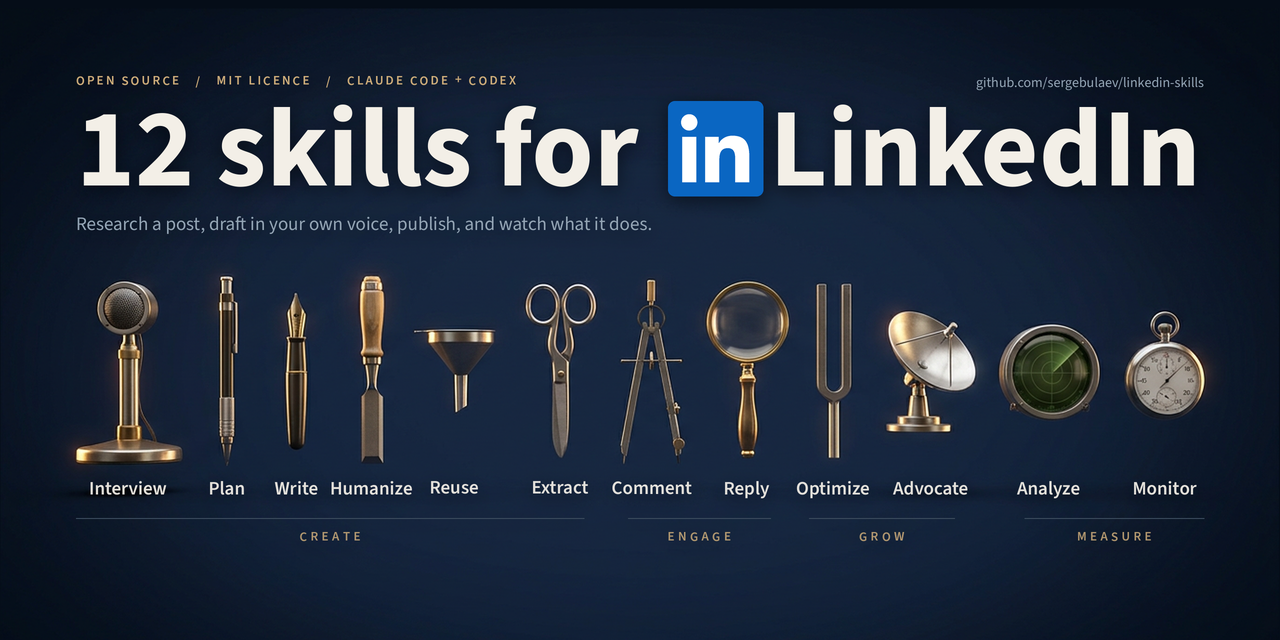
linkedin-post-writer— each team member uses this for individual draftslinkedin-profile-optimizer— team profiles should match before the program launches (otherwise profile clicks convert poorly)linkedin-content-planner— each team member gets their own pillar mixlinkedin-thread-monitor— track which team members' comments drive author replieslinkedin-engager-analytics— see who's engaging with each team member's postslinkedin-comment-drafter— its reshare mode is how team members amplify a brand or colleague post to their own feed with a short take (lib.repost(post_url, commentary)on approval); the cleanest advocacy action after an original post
Tips for Linkedin Employee Advocacy
- • Start a fresh session after installing so your agent picks up the new skill.
- • It bundles reference files. The agent reads them only when needed, so they cost no context until then.
- • It is part of a pack with 13 skills. Install only the ones you need with --skill to keep triggers precise.
- • If two skills overlap, mention the one you want by name.
Questions about Linkedin Employee Advocacy
What does the Linkedin Employee Advocacy skill do?
Stand up and run a LinkedIn employee advocacy program for a marketing or sales team. Covers 14-day launch playbook, brand-guideline governance, per-post time budget, cadence benchmarks, and team ROI (reach, engagement, pipeline). Triggers on "employee advocacy", "get the team posting", "scale LinkedIn across team", "advocacy ROI". Not for planning one person's own calendar (use linkedin-content-planner).
How do I install Linkedin Employee Advocacy?
Run "npx skills add sergebulaev/linkedin-skills --skill linkedin-employee-advocacy" in your project. The skills CLI installs it for Claude Code, Cursor, Codex and 70+ other agents. In Claude on the web, upload the skill folder as a ZIP under Customize > Skills.
Does Linkedin Employee Advocacy work in Cursor and Codex?
Yes. Linkedin Employee Advocacy uses the open SKILL.md format, so it works in Claude Code, Claude, Cursor, OpenAI Codex, Gemini CLI, GitHub Copilot and other agents that support agent skills.
Is Linkedin Employee Advocacy free?
Linkedin Employee Advocacy is open source on GitHub under the MIT license. It is free to install; check the license before commercial use.
Who made Linkedin Employee Advocacy?
Linkedin Employee Advocacy is published by sergebulaev in the sergebulaev/linkedin-skills repository, together with 12 other skills.