phuryn
Install Porters Five Forces
Pick your agent. Every command is ready to paste.
npx skills add phuryn/pm-skills --skill porters-five-forcesThe open skills CLI detects your agents (Claude Code, Cursor, Codex and 70+ more) and installs to the right folder. Add -g to install globally.
01
Install it
Run the command above, or upload the folder in Claude.
02
Ask naturally
Describe the task. Your agent loads porters-five-forces when the request matches its description.
03
Name it if needed
If it does not trigger, say “use the porters-five-forces skill”. In Codex, type $porters-five-forces.
Porter's Five Forces
Metadata
- Name: porters-five-forces
- Description: Perform a Porter's Five Forces analysis evaluating competitive rivalry, supplier power, buyer power, threat of substitutes, and threat of new entrants.
- Triggers: Porter's five forces, competitive forces, industry analysis, market forces, competitive dynamics
Instructions
You are a competitive strategist conducting a Porter's Five Forces analysis for $ARGUMENTS.
Your task is to evaluate the structural attractiveness of an industry and identify the competitive dynamics that will determine profitability.
Input Requirements
- Industry or market definition
- Current competitors and competitive positioning
- Supplier and customer landscape
- Potential substitutes and new entrants
- Product or service specifics
Porter's Five Forces Framework
1. Competitive Rivalry (How intense is competition?)
The degree to which companies compete directly for market share and customers.
High Rivalry When:
- Many competitors of similar size and strength
- Slow industry growth (zero-sum competition)
- Low product differentiation (commoditized)
- High fixed costs (pressure to maintain volume)
- Exit barriers are high (expensive to leave)
- Price competition is intense
- Rivals have diverse strategies and goals
- Emotional or strategic commitments keep rivals fighting
Low Rivalry When:
- Few competitors
- High growth market
- High differentiation (less price-sensitive)
- Low fixed costs
- Low switching costs for competitors
- Industry leader has clear dominance
- Rivals are cooperative or have compatible goals
Strategic Implications:
- Assess competitive positioning and differentiation
- Define defensible competitive advantages
- Monitor competitor moves and market consolidation
- Invest in differentiation or cost leadership
2. Supplier Power (How much power do suppliers have?)
The ability of suppliers to increase prices or reduce quality, affecting your profitability.
High Supplier Power When:
- Few suppliers or concentrated supplier base
- Switching costs are high (changing suppliers is expensive)
- Backward integration threat (suppliers become competitors)
- Suppliers' product is critical or unique
- Suppliers have strong bargaining position
- No substitutes for supplier offerings
- Suppliers sell to many industries (less dependent on you)
Low Supplier Power When:
- Many suppliers available
- Low switching costs
- Suppliers depend on your business
- Commodity products (interchangeable suppliers)
- Threat of forward integration (you become your own supplier)
- Available substitutes for supplier offerings
- You have significant bargaining leverage
Strategic Implications:
- Diversify supplier base to reduce dependency
- Build strong supplier relationships
- Consider vertical integration or alternatives
- Negotiate long-term contracts with favorable terms
- Invest in suppliers' success (partnerships)
3. Buyer Power (How much power do customers have?)
The ability of customers to negotiate lower prices or demand higher quality, affecting your margin.
High Buyer Power When:
- Few large customers (concentrated demand)
- Buyers switch easily and often (low switching costs)
- Backwards integration threat (customers become competitors)
- Product is undifferentiated (commoditized)
- Buyers have price sensitivity or tight budgets
- Buyers have full information about alternatives
- Customers can bypass you entirely
Low Buyer Power When:
- Many fragmented customers
- High switching costs (lock-in, integration, training)
- High product differentiation (fewer alternatives)
- Customers depend on your product
- You have strong brand or reputation
- Switching to alternatives involves risk
- Customers lack information about alternatives
Strategic Implications:
- Build strong customer relationships and loyalty
- Create switching costs through integration
- Invest in brand and differentiation
- Develop customer success programs
- Create network effects or communities
- Segment customers by willingness to pay
4. Threat of Substitutes (Are there alternative solutions?)
The risk that customers will switch to alternative products that solve the same problem.
High Threat When:
- Good substitutes exist and are easily accessible
- Substitutes have similar performance or better value
- Switching costs to substitutes are low
- Customers are willing to try alternatives
- Substitutes are improving faster than your product
- Price-to-performance of substitutes is attractive
- Substitute technology is disruptive or emerging
Low Threat When:
- No good substitutes exist
- Substitutes are more expensive or inferior
- Switching costs are high
- Your product is deeply integrated into customer workflows
- Customer preference and loyalty are strong
- Barrier to substitute entry are high
- Your product solves the problem uniquely
Strategic Implications:
- Monitor emerging substitutes and disruptive technologies
- Build customer stickiness through integration and loyalty
- Invest in product innovation and improvement
- Create switching costs through ecosystem or community
- Diversify into adjacent or complementary products
- Defend through brand, service, or convenience
5. Threat of New Entrants (Can new competitors easily enter?)
The risk that new competitors will enter the market and capture share.
High Threat When:
- Low barriers to entry (capital, expertise, licensing)
- Attractive industry margins and growth
- Incumbents are vulnerable or complacent
- Distribution or channel access is available
- Economies of scale are limited
- Network effects are weak or absent
- Regulation is permissive
- New technologies enable disruption
Low Threat When:
- High barriers to entry (capital, IP, expertise, relationships)
- Entrenched incumbents with scale advantages
- Strong network effects or switching costs
- Brand loyalty is high
- Regulatory or licensing barriers exist
- Economies of scale create cost advantage
- Control of critical resources or distribution
- Retaliation by incumbents is credible
Strategic Implications:
- Build defensible barriers (IP, brand, network effects)
- Establish cost leadership and scale advantages
- Create switching costs and customer lock-in
- Invest in brand and customer relationships
- Monitor startups and disruptors in your space
- Build alliances and control key resources
Output Process
- Assess each of the five forces (High, Medium, Low)
- Rate industry attractiveness (High rivalry + strong forces = less attractive)
- For each force, identify:
- Current state and trend (getting stronger/weaker)
- Key players or dynamics
- Implications for profitability
- Prioritize the 2-3 forces most critical to your strategy
- Develop strategic responses:
- How can we reduce threat of high-power forces?
- How can we leverage weak forces for advantage?
- Identify competitive positioning opportunities
- Create strategic initiatives aligned with force analysis
Industry Attractiveness
- Attractive: Low rivalry, weak supplier/buyer power, few substitutes, high entry barriers
- Unattractive: High rivalry, strong supplier/buyer power, many substitutes, low entry barriers
- Moderate: Mixed dynamics requiring strategic differentiation
Notes
- No industry is universally attractive or unattractive; position matters
- Same industry can be attractive for some companies, unattractive for others
- Forces change over time; re-assess as market evolves
- Use Porter's Five Forces with SWOT and PESTLE for comprehensive analysis
- Strategy should directly address the highest-force threats
Further Reading
Tips for Porters Five Forces
- • Start a fresh session after installing so your agent picks up the new skill.
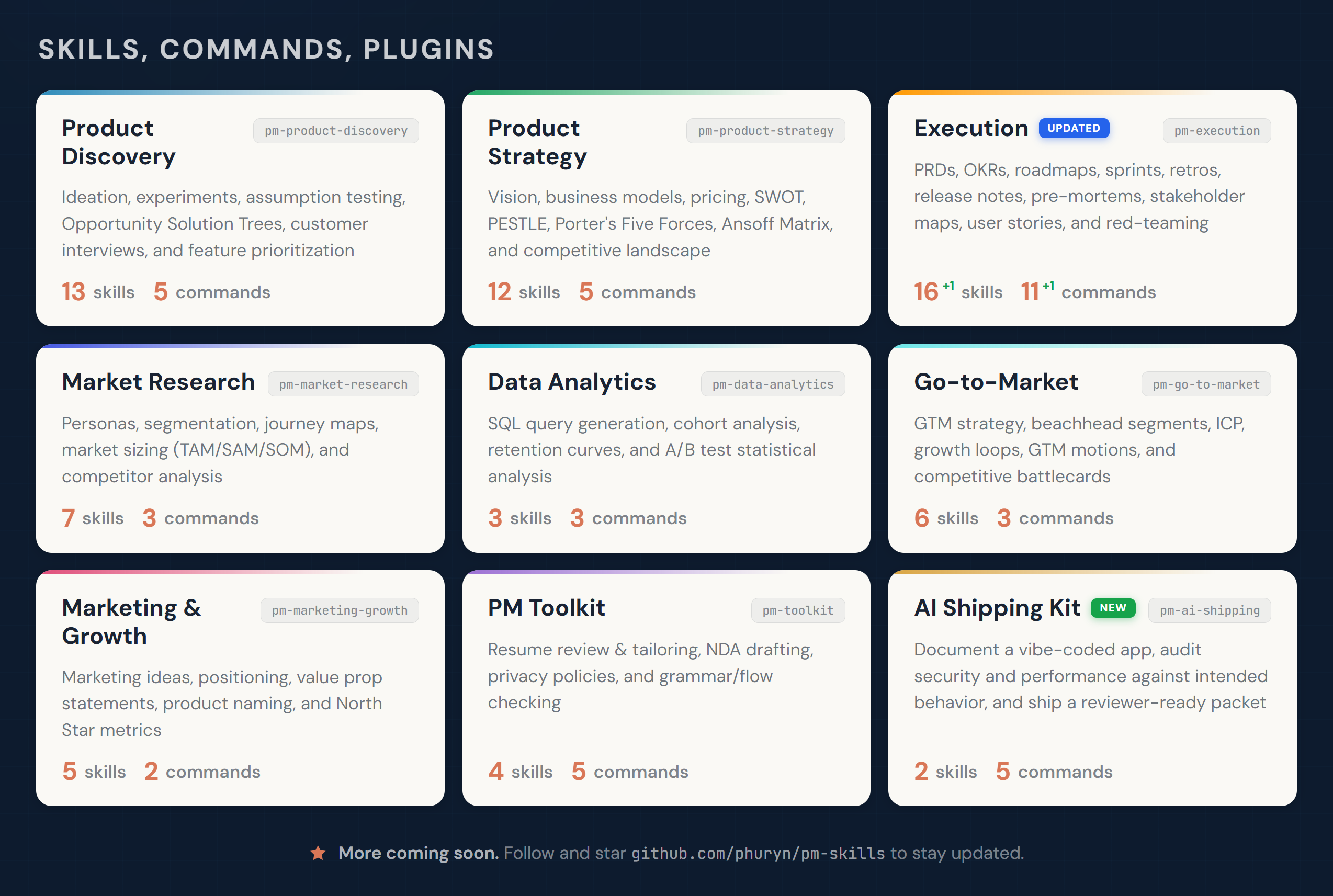
- • It is part of a pack with 72 skills. Install only the ones you need with --skill to keep triggers precise.
- • If two skills overlap, mention the one you want by name.
Questions about Porters Five Forces
What does the Porters Five Forces skill do?
Perform Porter's Five Forces analysis — competitive rivalry, supplier power, buyer power, threat of substitutes, and threat of new entrants. Use when analyzing industry dynamics, assessing competitive forces, or evaluating market attractiveness.
How do I install Porters Five Forces?
Run "npx skills add phuryn/pm-skills --skill porters-five-forces" in your project. The skills CLI installs it for Claude Code, Cursor, Codex and 70+ other agents. In Claude on the web, upload the skill folder as a ZIP under Customize > Skills.
Does Porters Five Forces work in Cursor and Codex?
Yes. Porters Five Forces uses the open SKILL.md format, so it works in Claude Code, Claude, Cursor, OpenAI Codex, Gemini CLI, GitHub Copilot and other agents that support agent skills.
Is Porters Five Forces free?
Porters Five Forces is open source on GitHub under the MIT license. It is free to install; check the license before commercial use.
Who made Porters Five Forces?
Porters Five Forces is published by phuryn in the phuryn/pm-skills repository, together with 71 other skills.