product-on-purpose
Install Discover Competitive Analysis
Pick your agent. Every command is ready to paste.
npx skills add product-on-purpose/pm-skills --skill discover-competitive-analysisThe open skills CLI detects your agents (Claude Code, Cursor, Codex and 70+ more) and installs to the right folder. Add -g to install globally.
01
Install it
Run the command above, or upload the folder in Claude.
02
Ask naturally
Describe the task. Your agent loads discover-competitive-analysis when the request matches its description.
03
Name it if needed
If it does not trigger, say “use the discover-competitive-analysis skill”. In Codex, type $discover-competitive-analysis.
Competitive Analysis
A competitive analysis provides structured insight into the competitive landscape, helping product teams understand where they stand relative to alternatives and identify opportunities for differentiation. Rather than exhaustively cataloging every competitor, an effective analysis focuses on actionable insights that inform product strategy.
When to Use
- Before entering a new market or launching a new product
- When planning differentiation strategy for an existing product
- During quarterly or annual strategic planning reviews
- When evaluating build vs. buy decisions
- After losing deals to understand competitive positioning
- When onboarding new product team members to the market context
When NOT to Use
- You need market size rather than competitor positioning -> use
discover-market-sizing - You are stress-testing strategic differentiation across the whole business model -> use
foundation-lean-canvas, ortool-foundation-sprint-differentiationinside a Foundation Sprint - You want to understand why customers switch products -> use
define-jtbd-canvas; it examines competing solutions through the job lens - The landscape is already mapped and you need the problem framed -> use
define-problem-statement
Instructions
When asked to create a competitive analysis, follow these steps:
Define the Scope Clarify what you're analyzing: a specific feature area, overall product positioning, or pricing strategy. Identify 3-5 key competitors: direct competitors (same solution), indirect competitors (different solution to same problem), and potential disruptors.
Gather Intelligence Research each competitor through public sources: websites, pricing pages, G2/Capterra reviews, press releases, job postings, and customer testimonials. Note what you can verify vs. what you're inferring.
Build the Feature Matrix Create a comparison grid of key capabilities. Focus on features that matter to your target customers, not exhaustive checklists. Use consistent ratings (e.g., Full, Partial, None, Unknown).
Analyze Positioning Map competitors on a 2x2 positioning matrix using dimensions relevant to your market (e.g., price vs. features, ease of use vs. power, SMB vs. enterprise). Identify white space opportunities.
Assess Strengths and Weaknesses For each competitor, document genuine strengths (what they do better than you) and weaknesses (where they fall short). Avoid dismissing competitors. Respect drives better strategy.
Identify Strategic Implications Translate observations into actionable recommendations: where to compete head-on, where to differentiate, what messaging to emphasize, and what gaps represent opportunities.
Note Confidence Levels Mark which conclusions are based on verified data vs. inference. Competitive intelligence has varying reliability. Be honest about uncertainty.
Output Format
Use the template in references/TEMPLATE.md to structure the output. A complete analysis fills every template section: Overview; Market Context; Competitors Analyzed; Feature Comparison Matrix; Pricing Comparison; Positioning Map; Competitor Deep Dives; Competitive Gaps and Opportunities; Strategic Recommendations; Sources and Confidence; and Next Steps.
Quality Checklist
Before finalizing, verify:
- Scope is clearly defined (what market, segment, use case)
- 3-5 competitors are analyzed, including direct and indirect
- Feature comparison focuses on customer-relevant capabilities
- Positioning map uses meaningful, differentiated dimensions
- Strengths acknowledge where competitors genuinely excel
- Recommendations are specific and actionable
- Sources and confidence levels are documented
Examples
See references/EXAMPLE.md for a completed example.
Tips for Discover Competitive Analysis
- • Start a fresh session after installing so your agent picks up the new skill.
- • It bundles reference files. The agent reads them only when needed, so they cost no context until then.
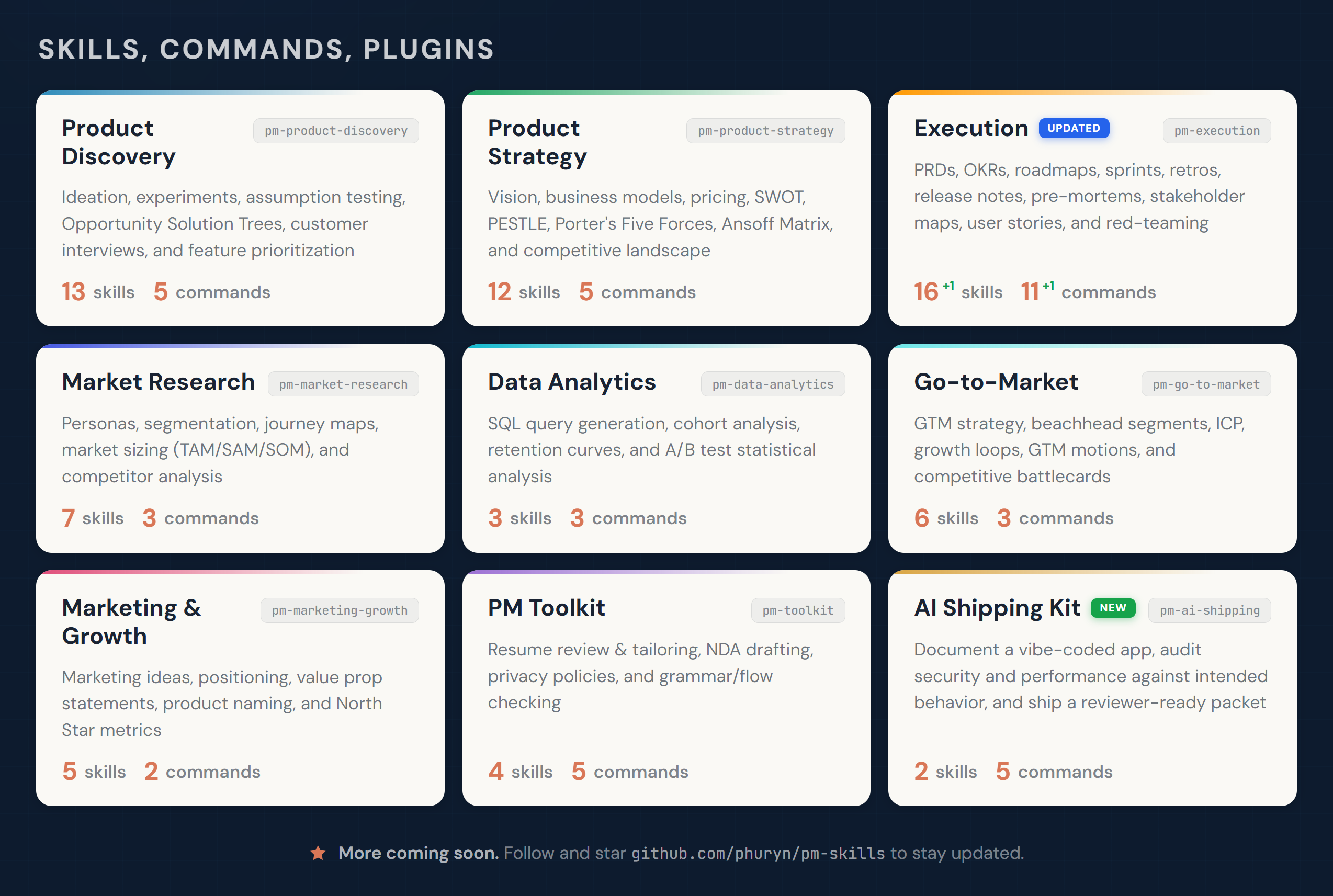
- • It is part of a pack with 30 skills. Install only the ones you need with --skill to keep triggers precise.
- • If two skills overlap, mention the one you want by name.
Questions about Discover Competitive Analysis
What does the Discover Competitive Analysis skill do?
Creates a structured competitive analysis comparing features, pricing, and positioning across 3-5 direct and indirect competitors, with a 2x2 map and actionable strategic recommendations. Use before entering a market, planning differentiation, or after losing deals. For market size rather than competitor positioning, use discover-market-sizing instead.
How do I install Discover Competitive Analysis?
Run "npx skills add product-on-purpose/pm-skills --skill discover-competitive-analysis" in your project. The skills CLI installs it for Claude Code, Cursor, Codex and 70+ other agents. In Claude on the web, upload the skill folder as a ZIP under Customize > Skills.
Does Discover Competitive Analysis work in Cursor and Codex?
Yes. Discover Competitive Analysis uses the open SKILL.md format, so it works in Claude Code, Claude, Cursor, OpenAI Codex, Gemini CLI, GitHub Copilot and other agents that support agent skills.
Is Discover Competitive Analysis free?
Discover Competitive Analysis is open source on GitHub under the Apache-2.0 license. It is free to install; check the license before commercial use.
Who made Discover Competitive Analysis?
Discover Competitive Analysis is published by product-on-purpose in the product-on-purpose/pm-skills repository, together with 29 other skills.