product-on-purpose
Install Deliver Acceptance Criteria
Pick your agent. Every command is ready to paste.
npx skills add product-on-purpose/pm-skills --skill deliver-acceptance-criteriaThe open skills CLI detects your agents (Claude Code, Cursor, Codex and 70+ more) and installs to the right folder. Add -g to install globally.
01
Install it
Run the command above, or upload the folder in Claude.
02
Ask naturally
Describe the task. Your agent loads deliver-acceptance-criteria when the request matches its description.
03
Name it if needed
If it does not trigger, say “use the deliver-acceptance-criteria skill”. In Codex, type $deliver-acceptance-criteria.
Acceptance Criteria
Acceptance criteria define the observable behavior that must be true for a story or feature to be considered done. This skill turns feature context into concise, testable Given/When/Then scenarios that engineers and QA can verify without guessing intent.
When to Use
- After a user story, PRD section, or feature slice is defined
- When a team needs clear pass/fail conditions for implementation
- When writing QA-ready criteria for sprint planning or handoff
- When a story has edge cases, error paths, or non-functional expectations that should be explicit
When NOT to Use
- You need the user stories themselves -> use
deliver-user-stories; this skill deepens a story that already exists - You need systematic failure coverage across a whole feature -> use
deliver-edge-cases; this skill stays story-scoped - There is no story or slice to bind criteria to yet -> use
deliver-prdordeliver-user-storiesfirst - You are defining success metrics for an experiment, not done-ness for a story -> use
measure-experiment-design - The criterion is a rate over model output, such as "90% of answers are faithful to their sources" -> use the AI Behavior and Evaluation section of
deliver-prd, which says a rate needs a designed sample to verify it, and what to record until one exists
Instructions
When asked to create acceptance criteria, follow these steps:
Confirm the story or feature scope Identify the exact slice of work. If the scope is unclear, ask for the user story, PRD section, or feature description before drafting criteria.
Separate the happy path from exceptions Start with the primary success flow, then add edge cases and error states that are likely or costly if missed.
Write each criterion as an observable scenario Use Given/When/Then language only. Keep each criterion independently testable and avoid implementation details.
Cover recovery and failure behavior Describe what the user sees or can do when validation fails, a dependency is unavailable, or a save action cannot complete.
Include non-functional expectations Add criteria for performance, accessibility, security, reliability, or auditability when they matter to the story.
Avoid duplication and overlap Each criterion should test one outcome. If two criteria describe the same behavior, merge or split them until the intent is clear.
Review for testability Ensure a reviewer can pass or fail each criterion without interpretation. If a statement is subjective, rewrite it into a measurable outcome.
Output Contract
Use references/TEMPLATE.md as the output format. A complete response should:
- Restate the feature or story context
- Group criteria into happy path, edge cases, error states, and non-functional criteria
- Use explicit Given/When/Then statements for each criterion
- Note assumptions or open questions when context is incomplete
Quality Checklist
Before finalizing, verify:
- The criteria map to a specific story or feature slice
- The happy path is covered first
- Edge cases are explicit, not implied
- Error states include user-visible recovery behavior
- Non-functional criteria are included when relevant
- Each criterion is testable and has one clear outcome
- No implementation details leak into the acceptance criteria
Examples
See references/EXAMPLE.md for a completed example based on a realistic e-commerce checkout flow.
Tips for Deliver Acceptance Criteria
- • Start a fresh session after installing so your agent picks up the new skill.
- • It bundles reference files. The agent reads them only when needed, so they cost no context until then.
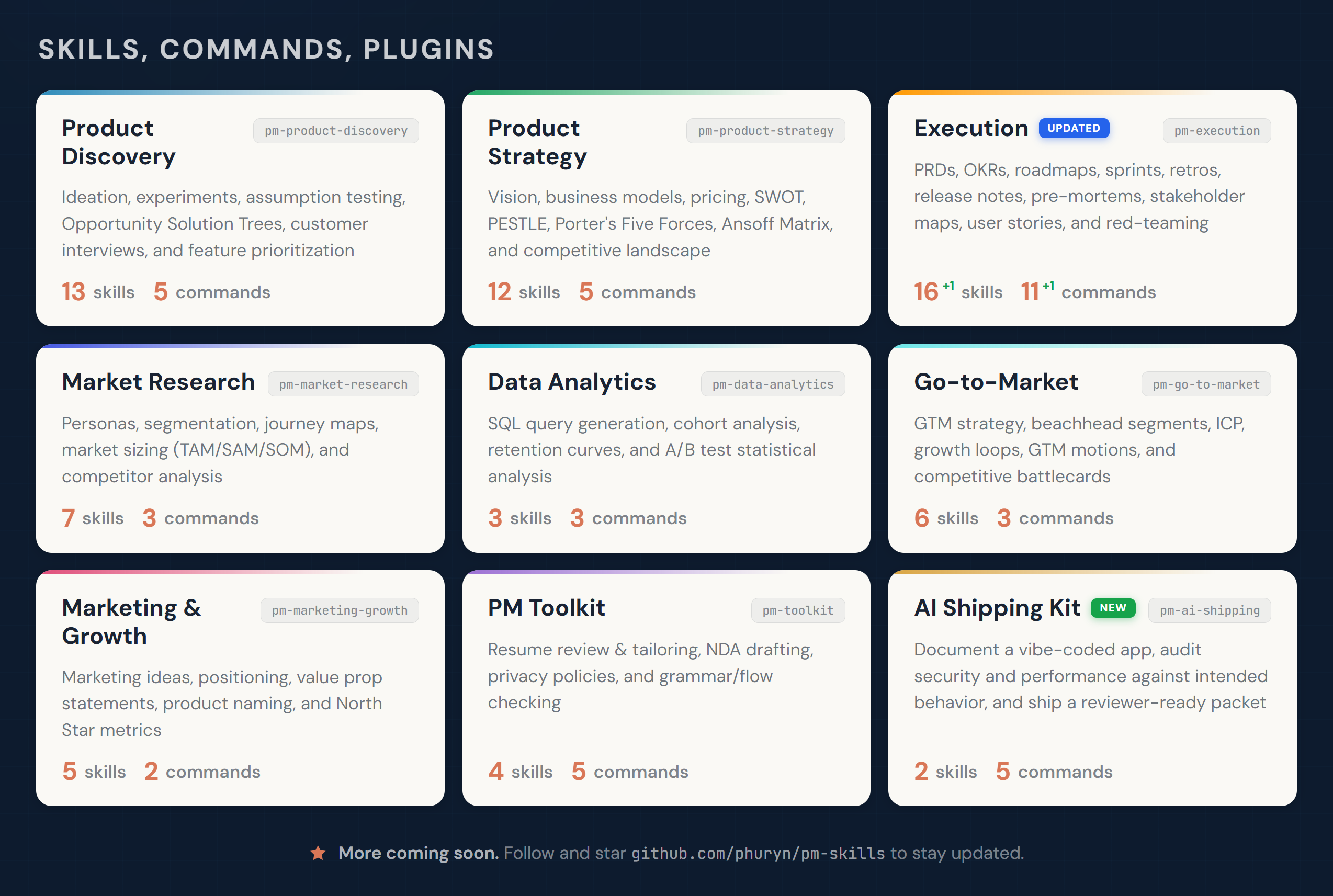
- • It is part of a pack with 30 skills. Install only the ones you need with --skill to keep triggers precise.
- • If two skills overlap, mention the one you want by name.
Questions about Deliver Acceptance Criteria
What does the Deliver Acceptance Criteria skill do?
Generates structured Given/When/Then acceptance criteria for a user story or feature slice, covering the happy path, key failure scenarios, and non-functional expectations in testable form. Use when turning requirements into verifiable scenarios for engineering handoff and QA sign-off. For a dedicated catalog of boundary conditions, error states, and recovery paths across a feature, use deliver-edge-cases; to write t
How do I install Deliver Acceptance Criteria?
Run "npx skills add product-on-purpose/pm-skills --skill deliver-acceptance-criteria" in your project. The skills CLI installs it for Claude Code, Cursor, Codex and 70+ other agents. In Claude on the web, upload the skill folder as a ZIP under Customize > Skills.
Does Deliver Acceptance Criteria work in Cursor and Codex?
Yes. Deliver Acceptance Criteria uses the open SKILL.md format, so it works in Claude Code, Claude, Cursor, OpenAI Codex, Gemini CLI, GitHub Copilot and other agents that support agent skills.
Is Deliver Acceptance Criteria free?
Deliver Acceptance Criteria is open source on GitHub under the Apache-2.0 license. It is free to install; check the license before commercial use.
Who made Deliver Acceptance Criteria?
Deliver Acceptance Criteria is published by product-on-purpose in the product-on-purpose/pm-skills repository, together with 29 other skills.