product-on-purpose
Install Define Hypothesis
Pick your agent. Every command is ready to paste.
npx skills add product-on-purpose/pm-skills --skill define-hypothesisThe open skills CLI detects your agents (Claude Code, Cursor, Codex and 70+ more) and installs to the right folder. Add -g to install globally.
01
Install it
Run the command above, or upload the folder in Claude.
02
Ask naturally
Describe the task. Your agent loads define-hypothesis when the request matches its description.
03
Name it if needed
If it does not trigger, say “use the define-hypothesis skill”. In Codex, type $define-hypothesis.
Hypothesis
A hypothesis is a testable prediction about how a change will affect user behavior or business outcomes. It transforms assumptions into explicit statements that can be validated or invalidated through experimentation. Well-formed hypotheses prevent teams from building features based on untested beliefs and create shared understanding of what success looks like.
When to Use
- After problem framing, before committing to a solution
- When designing experiments or A/B tests
- When team members have differing assumptions about user behavior
- Before investing significant engineering resources in a feature
- When pivoting direction and need to validate the new approach
When NOT to Use
- You are ready to design the actual A/B test (variants, sample size, duration) -> use
measure-experiment-design; this skill frames what to test, not how - The problem itself is still unframed -> use
define-problem-statementfirst - You want to organize many assumptions and ideas into a discovery structure -> use
define-opportunity-tree - The team needs the full business-model picture, not one testable claim -> use
foundation-lean-canvas
Instructions
When asked to create a hypothesis, follow these steps:
State the Belief Articulate what you believe will happen. Use the structured format: "We believe that [action/change] for [target user] will [expected outcome]." Be specific about the intervention - vague hypotheses can't be tested.
Identify the Target User Define who this hypothesis applies to. A hypothesis about "users" is too broad. Specify the segment: new users in their first week, power users with 10+ sessions, churned users returning, etc.
Define the Expected Outcome What behavior change or result do you expect? Frame it in terms of user actions (complete onboarding, make a purchase, return within 7 days) rather than internal metrics when possible.
Set Success Metrics Choose a primary metric that directly measures the expected outcome. Include secondary metrics that provide context and guardrail metrics that ensure you're not causing harm elsewhere.
Describe Validation Approach How will you test this hypothesis? A/B test, user interviews, prototype testing, cohort analysis? Be specific about sample size, duration, and statistical requirements.
Document Risks and Assumptions What could invalidate this hypothesis beyond the test results? What are you assuming to be true that you haven't validated?
Output Format
Use the template in references/TEMPLATE.md to structure the output. A complete hypothesis document fills every template section: Hypothesis Statement; Background & Rationale; Target User Segment; Success Metrics; Validation Approach; Risks & Assumptions; and Timeline.
Quality Checklist
Before finalizing, verify:
- Hypothesis is falsifiable (possible to prove wrong)
- Success metric has a specific numeric target
- Target user segment is clearly defined
- Validation approach is practical and time-bound
- Pass/fail criteria are unambiguous
- Hypothesis doesn't assume the solution works
Examples
See references/EXAMPLE.md for a completed example.
Tips for Define Hypothesis
- • Start a fresh session after installing so your agent picks up the new skill.
- • It bundles reference files. The agent reads them only when needed, so they cost no context until then.
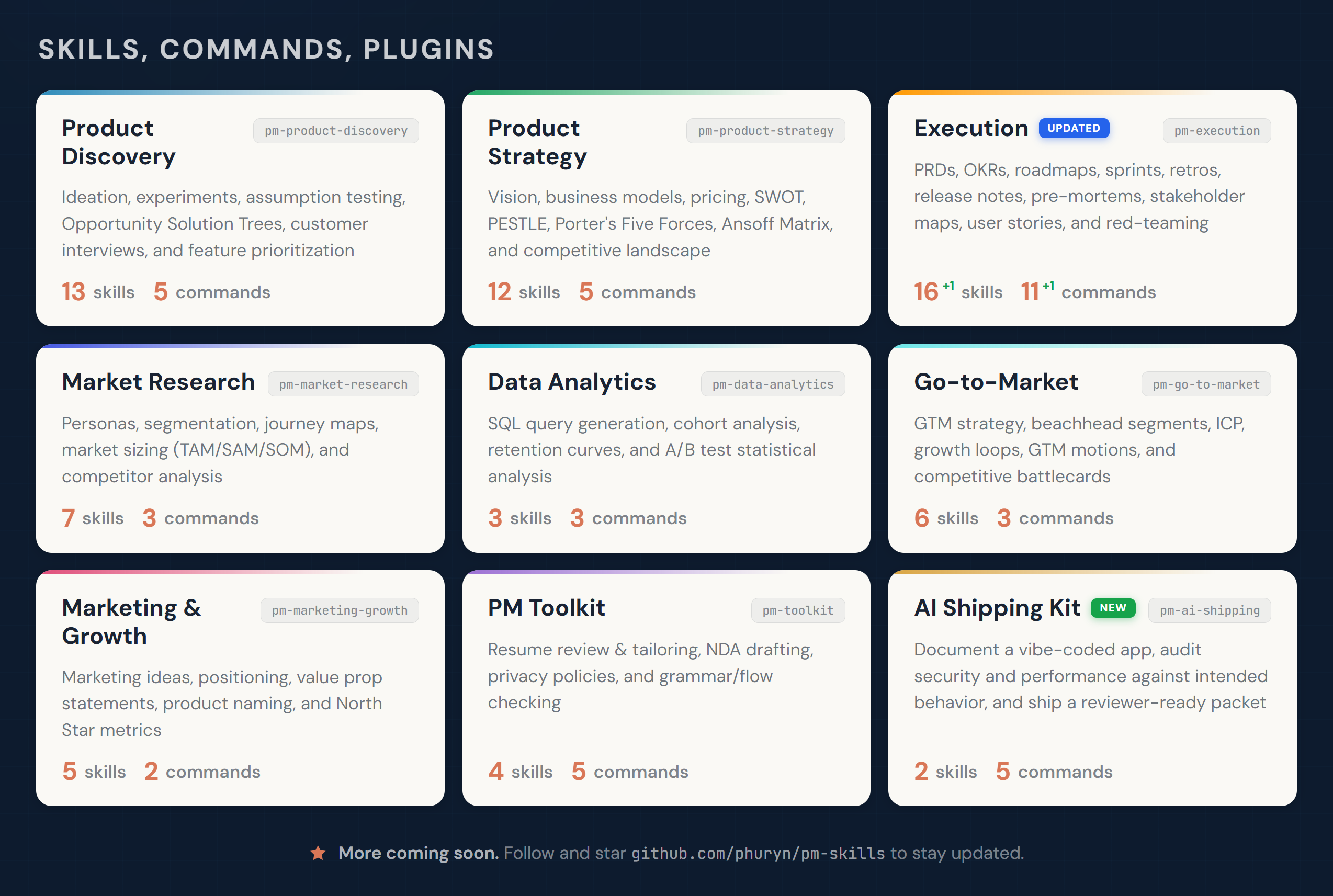
- • It is part of a pack with 30 skills. Install only the ones you need with --skill to keep triggers precise.
- • If two skills overlap, mention the one you want by name.
Questions about Define Hypothesis
What does the Define Hypothesis skill do?
Defines a testable hypothesis with clear success metrics and a validation approach. Use when forming assumptions to test or aligning a team on what success looks like, before any experiment is designed. To design the A/B test or experiment that will validate the hypothesis, use measure-experiment-design.
How do I install Define Hypothesis?
Run "npx skills add product-on-purpose/pm-skills --skill define-hypothesis" in your project. The skills CLI installs it for Claude Code, Cursor, Codex and 70+ other agents. In Claude on the web, upload the skill folder as a ZIP under Customize > Skills.
Does Define Hypothesis work in Cursor and Codex?
Yes. Define Hypothesis uses the open SKILL.md format, so it works in Claude Code, Claude, Cursor, OpenAI Codex, Gemini CLI, GitHub Copilot and other agents that support agent skills.
Is Define Hypothesis free?
Define Hypothesis is open source on GitHub under the Apache-2.0 license. It is free to install; check the license before commercial use.
Who made Define Hypothesis?
Define Hypothesis is published by product-on-purpose in the product-on-purpose/pm-skills repository, together with 29 other skills.