plugin87
Install Brandkit
Pick your agent. Every command is ready to paste.
npx skills add plugin87/ux-ui-agent-skills --skill brandkitThe open skills CLI detects your agents (Claude Code, Cursor, Codex and 70+ more) and installs to the right folder. Add -g to install globally.
01
Install it
Run the command above, or upload the folder in Claude.
02
Ask naturally
Describe the task. Your agent loads brandkit when the request matches its description.
03
Name it if needed
If it does not trigger, say “use the brandkit skill”. In Codex, type $brandkit.
The skill itself
SKILL.md
Skill: Brand Kit
Requirements
This skill needs the full UX/UI Agent Skills kit: the gates, the references and
the design-system library. Install it with npx ux-ui-agent-skills@3.1.0 init
or as the Claude Code plugin. npx skills@1.7.6 add copies the skill folder and
nothing else. Installed that way, this skill runs in guidance-only mode: no gate
runs, so it gives no verdict.
Step 0: is the kit here? Check once:
ls ${CLAUDE_SKILL_DIR}/../../../tokens >/dev/null 2>&1 && echo KIT_OK || echo KIT_MISSINGOnKIT_MISSING, open your reply with: "Guidance-only mode: the UX/UI Agent Skills kit is not installed here, so no gate ran and nothing below is measured." Then work from this file and general practice, under three rules. Do not guess or cite the contents of a kit file you could not open. State no measured number (no contrast ratio, no N/N, no "passes WCAG"): write "not verified" where one would go. End with a lineSkipped (kit not installed):that names every gate script this file tells you to run, then the install command above.
Stand up the foundation (one token system everything renders from) before any screen. Get this right and every page stays consistent and themeable from one place.
Steps
- Brief Inference (mandatory): name the industry, audience, the one mood adjective, and motion depth (
${CLAUDE_SKILL_DIR}/../../../taste/design-taste.md→ Brief Inference). Pick an anchoring archetype from${CLAUDE_SKILL_DIR}/../../../taste/aesthetic-systems.md. - Primitives: generate the brand color ramp in OKLCH (11 shades, consistent chroma) + a neutral ramp; verify the 500 shade ≥ 4.5:1 on white (text) and 600 ≥ 3:1 (UI) per
${CLAUDE_SKILL_DIR}/../../../.claude/rules/tokens-and-color.md→ Color Generation. - Semantic layer: map roles to primitives (
action.primary/-hover/destructive,text.{primary,secondary,on-action,link},surface.{page,card,raised},border.{default,strong},feedback.{success,warning,error,info}), and the dark overrides (designed, not inverted). - Scales: Major Third type scale + composite text styles, 4px spacing scale, radius tiers, elevation, and
${CLAUDE_SKILL_DIR}/../../../tokens/motion.json-style durations/easings. - Emit the DTCG
${CLAUDE_SKILL_DIR}/../../../tokens/*.json(3-tier) + a singletheme.css(the one shared source,[data-theme="dark"]overrides). Optionally feed the token-build pipeline (token-buildskill) for other platforms.
Verification (definition of done)
python3 ${CLAUDE_SKILL_DIR}/../../../scripts/validate_tokens.py: valid JSON, all aliases resolve.python3 ${CLAUDE_SKILL_DIR}/../../../scripts/validate_contrast.py: required text/action/border pairs pass WCAG AA in light AND dark;border.strong≥ 3:1.python3 ${CLAUDE_SKILL_DIR}/../../../scripts/validate_theme_refs.py: every componentvar(--…)resolves to the theme.- One theme, no per-page palettes; destructive = danger token (not primary); zero hardcoded values.
Output is a verified token foundation: the measurable part is provable (run
npm run verify). Brand "feel" still benefits from a human review against${CLAUDE_SKILL_DIR}/../../../taste/design-taste.md.
Tips for Brandkit
- • Start a fresh session after installing so your agent picks up the new skill.
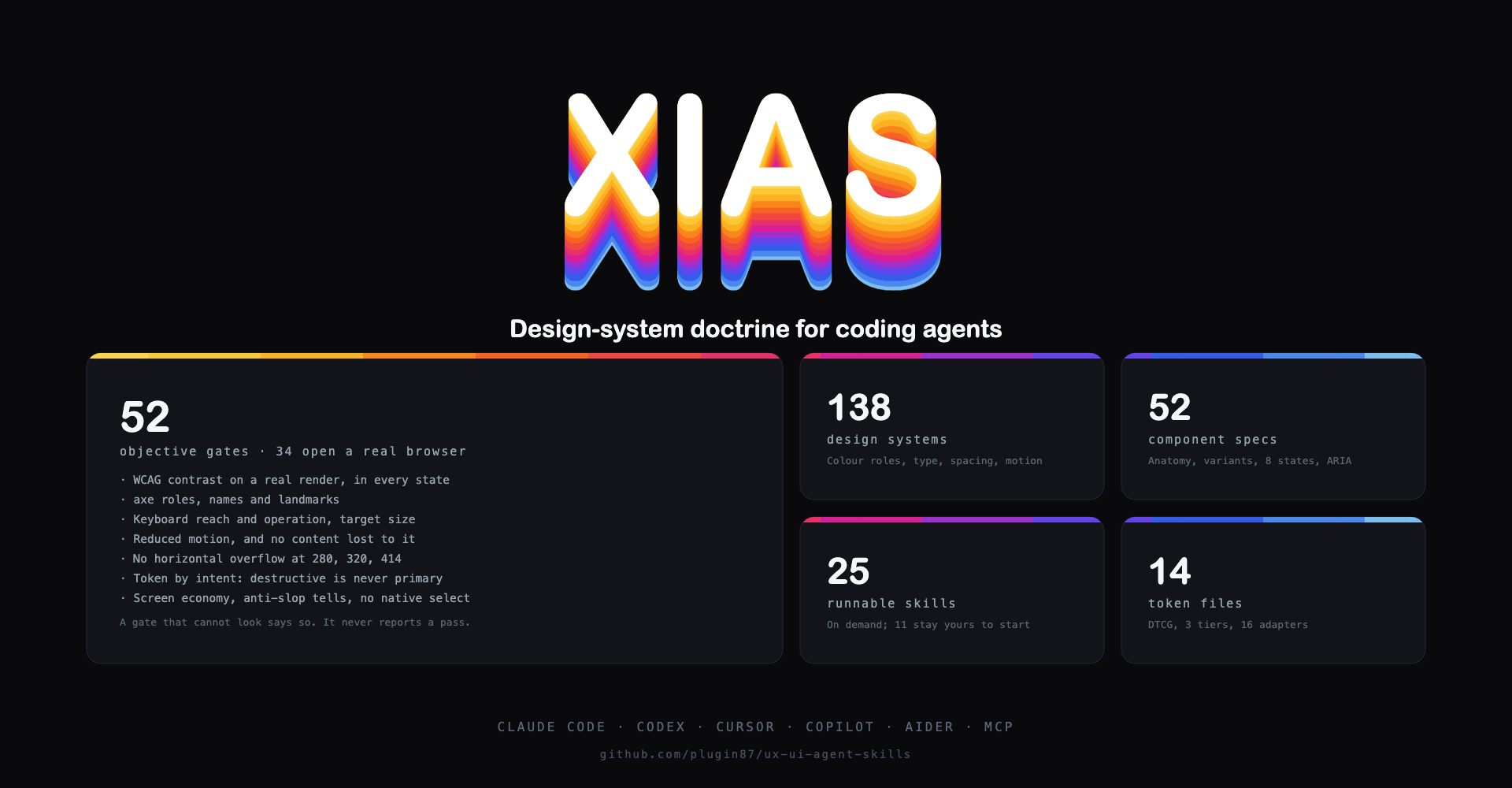
- • It is part of a pack with 26 skills. Install only the ones you need with --skill to keep triggers precise.
- • If two skills overlap, mention the one you want by name.
Questions about Brandkit
What does the Brandkit skill do?
Generate a complete, accessible brand design system from a brief, as primitive → semantic → component DTCG tokens (color, type, spacing, radius, shadow, motion), light + dark, plus a single theme.css, verified for WCAG. Use when the user wants a from-scratch brand/design foundation, a new palette + type system, or a themeable token kit for a product.
How do I install Brandkit?
Run "npx skills add plugin87/ux-ui-agent-skills --skill brandkit" in your project. The skills CLI installs it for Claude Code, Cursor, Codex and 70+ other agents. In Claude on the web, upload the skill folder as a ZIP under Customize > Skills.
Does Brandkit work in Cursor and Codex?
Yes. Brandkit uses the open SKILL.md format, so it works in Claude Code, Claude, Cursor, OpenAI Codex, Gemini CLI, GitHub Copilot and other agents that support agent skills.
Is Brandkit free?
Brandkit is open source on GitHub under the MIT license. It is free to install; check the license before commercial use.
Who made Brandkit?
Brandkit is published by plugin87 in the plugin87/ux-ui-agent-skills repository, together with 25 other skills.