plugin87
Install Grill Me
Pick your agent. Every command is ready to paste.
npx skills add plugin87/ux-ui-agent-skills --skill grill-meThe open skills CLI detects your agents (Claude Code, Cursor, Codex and 70+ more) and installs to the right folder. Add -g to install globally.
01
Install it
Run the command above, or upload the folder in Claude.
02
Ask naturally
Describe the task. Your agent loads grill-me when the request matches its description.
03
Name it if needed
If it does not trigger, say “use the grill-me skill”. In Codex, type $grill-me.
The skill itself
SKILL.md
Requirements
This skill needs the full UX/UI Agent Skills kit: the gates, the references and
the design-system library. Install it with npx ux-ui-agent-skills@3.1.0 init
or as the Claude Code plugin. npx skills@1.7.6 add copies the skill folder and
nothing else. Installed that way, this skill runs in guidance-only mode: no gate
runs, so it gives no verdict.
Step 0: is the kit here? Check once:
ls ${CLAUDE_SKILL_DIR}/../../../tokens >/dev/null 2>&1 && echo KIT_OK || echo KIT_MISSINGOnKIT_MISSING, open your reply with: "Guidance-only mode: the UX/UI Agent Skills kit is not installed here, so no gate ran and nothing below is measured." Then work from this file and general practice, under three rules. Do not guess or cite the contents of a kit file you could not open. State no measured number (no contrast ratio, no N/N, no "passes WCAG"): write "not verified" where one would go. End with a lineSkipped (kit not installed):that names every gate script this file tells you to run, then the install command above.
The gates catch a screen built wrongly. Nothing in this repo catches a screen
built correctly from the wrong brief, and that is where the expensive rework
comes from: four eval runs scored 14/14 on the gates and still came back from
/critique as rework, every finding a decision no gate can see.
This command spends five minutes up front to remove that class of failure.
Target: $ARGUMENTS (the thing about to be built; if that is not clear, that is
itself the first question).
1. Read before you ask
Asking for something the repo already answers is noise, and it teaches the user that answering you is a waste of time. Before writing a single question:
- Look for an existing brief,
CLAUDE.md,BRIEF.md, or areference/folder. - Look for an existing theme:
${CLAUDE_SKILL_DIR}/../../../tokens/*.json,design-tokens.json,theme.css. If one exists, the theme question is answered. Do not ask it. - Look at the neighbouring screens and components. Framework, conventions, and the component inventory are usually visible, not unknown.
Every question you keep after this pass is one the code genuinely cannot answer.
2. The bank, grouped by what no gate can see
Pick from these. Do not ask all of them.
Purpose and lead
- Who is this for, and what is the one task they came to finish?
- What is the first thing their eye should land on? (Four equal cards means the answer is "nothing", and that is a composition bug before it is a design.)
- What does success look like for them? What have they done when they leave?
Content reality
- What does this look like with zero items? With one? With four hundred?
- What is the longest string a real user will put in here: a 60-character project name, a nine-digit amount, an email with no spaces to break?
- Which numbers are real and which are placeholder? Placeholder that ships as real is a lie the user catches immediately.
Irreversible actions
- Which actions here destroy or cannot be undone, and what confirms them? (Destructive wears the danger variant in every place it appears: the trigger and the confirm dialog both. A blue Delete is an automatic fail.)
- What happens when the action fails? What does the user read, and what can they do next?
Theme and platform
- New theme or existing? If new: which direction, and does dark mode ship too?
- What is the narrowest width this must survive? (The kit's floor is 280px.)
- Which framework is the deliverable, and does it need RTL, AA or AAA?
Scope and done
- How many screens or components exactly, and what is explicitly out of scope?
- What has to be true before this is done: which gates, and is
/critiquepart of the bar or not?
3. The rule on asking
- Maximum seven questions, asked in one round. A drip of one question at a time is worse than a wrong assumption.
- Every question must change the work. If both answers produce the same build, it is not a question, it is a default. Take it and say so.
- Never ask what you can choose well. Taste is the job. Ask about intent, content, and constraint; decide the rest.
4. Everything unasked becomes a written assumption
An assumption held silently is indistinguishable from a guess. Each one gets a line: what was assumed, the default taken, and what it costs if it is wrong.
Assumption: no dark mode requested -> shipping both anyway (the theme is already
dual, so the cost of including it is zero and the cost of retrofitting is not).
5. Output: a brief that can be checked later
Write BRIEF.md next to the work, in this shape:
# <what is being built>

Goal            one sentence, from the user's side
User and task   who, and the task they came to finish
Deliverables    exact list; N screens means N screens
Lead            the one thing the eye lands on first
Content reality empty / one / many, longest string, real vs placeholder
Irreversible    which actions, what confirms them, what failure reads like
Theme           source of truth, dark mode, brand direction
Platform floor  narrowest width, framework, RTL, AA or AAA
Out of scope    what this is deliberately not
Assumptions     each with its default and its cost if wrong
Done when       the gates that must pass, and whether /critique is part of the bar
This file is the thing /critique and a later reviewer argue against. A brief
that lives only in the conversation cannot be checked, and so it will not be.
6. Then build, then prove it
/grill-me -> build -> /gate -> /critique. This command removes ambiguity.
It does not produce quality, it does not score anything, and it is not a
substitute for rendering the work and looking at it.
Tips for Grill Me
- • Start a fresh session after installing so your agent picks up the new skill.
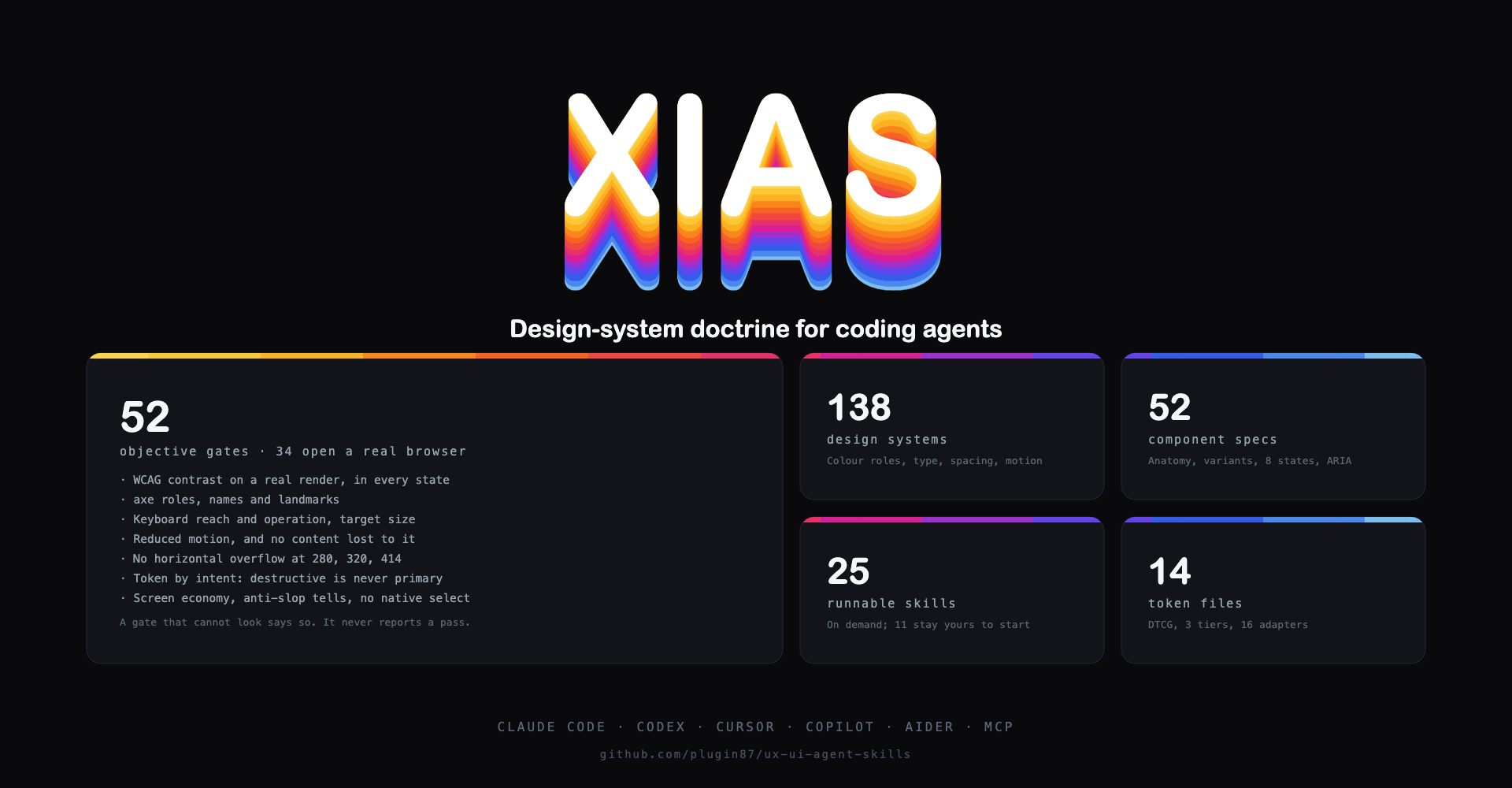
- • It is part of a pack with 26 skills. Install only the ones you need with --skill to keep triggers precise.
- • If two skills overlap, mention the one you want by name.
Questions about Grill Me
What does the Grill Me skill do?
Interrogate the brief before a line is built. Ask only the questions whose answers change the work, and put every unasked decision on the record as a stated assumption.
How do I install Grill Me?
Run "npx skills add plugin87/ux-ui-agent-skills --skill grill-me" in your project. The skills CLI installs it for Claude Code, Cursor, Codex and 70+ other agents. In Claude on the web, upload the skill folder as a ZIP under Customize > Skills.
Does Grill Me work in Cursor and Codex?
Yes. Grill Me uses the open SKILL.md format, so it works in Claude Code, Claude, Cursor, OpenAI Codex, Gemini CLI, GitHub Copilot and other agents that support agent skills.
Is Grill Me free?
Grill Me is open source on GitHub under the MIT license. It is free to install; check the license before commercial use.
Who made Grill Me?
Grill Me is published by plugin87 in the plugin87/ux-ui-agent-skills repository, together with 25 other skills.