plugin87
Install Image To Code
Pick your agent. Every command is ready to paste.
npx skills add plugin87/ux-ui-agent-skills --skill image-to-codeThe open skills CLI detects your agents (Claude Code, Cursor, Codex and 70+ more) and installs to the right folder. Add -g to install globally.
01
Install it
Run the command above, or upload the folder in Claude.
02
Ask naturally
Describe the task. Your agent loads image-to-code when the request matches its description.
03
Name it if needed
If it does not trigger, say “use the image-to-code skill”. In Codex, type $image-to-code.
The skill itself
SKILL.md
Skill: Image to Code
Requirements
This skill needs the full UX/UI Agent Skills kit: the gates, the references and
the design-system library. Install it with npx ux-ui-agent-skills@3.1.0 init
or as the Claude Code plugin. npx skills@1.7.6 add copies the skill folder and
nothing else. Installed that way, this skill runs in guidance-only mode: no gate
runs, so it gives no verdict.
Step 0: is the kit here? Check once:
ls ${CLAUDE_SKILL_DIR}/../../../tokens >/dev/null 2>&1 && echo KIT_OK || echo KIT_MISSINGOnKIT_MISSING, open your reply with: "Guidance-only mode: the UX/UI Agent Skills kit is not installed here, so no gate ran and nothing below is measured." Then work from this file and general practice, under three rules. Do not guess or cite the contents of a kit file you could not open. State no measured number (no contrast ratio, no N/N, no "passes WCAG"): write "not verified" where one would go. End with a lineSkipped (kit not installed):that names every gate script this file tells you to run, then the install command above.
Reconstruct a design from a visual reference as a real design system, not a one-off copy. Match the system (color/type/spacing language), never lift copyrighted imagery or brand assets.
Steps
- Read the reference like a designer. Infer and write down:
- Palette: 1 dominant surface family, text colors, 1 primary action + at most 1 accent (sample the hues; don't guess random hex).
- Type: family feel (geometric/grotesk/serif), the scale jumps, display vs. body contrast, weights.
- Spacing & density: base unit, section rhythm, card padding; airy vs. compact.
- Radius & depth: radius language (sharp/soft/pill), shadow vs. hairline separation.
- Layout archetype + sequence: bounded hero / asymmetric split / dense bento / editorial stack (
${CLAUDE_SKILL_DIR}/../../../taste/design-taste.md→ Variance Mandate).
- Anchor to a known system if it's close: browse
${CLAUDE_SKILL_DIR}/../../../taste/aesthetic-systems.md/python3 ${CLAUDE_SKILL_DIR}/../../../scripts/design_systems.py search <term>and adopt that recipe to stabilize decisions. - Build the token theme from the inferred values → 3-tier DTCG (
design-tokensskill); generate a singletheme.css. Verify every color pair with${CLAUDE_SKILL_DIR}/../../../scripts/contrast.py/${CLAUDE_SKILL_DIR}/../../../scripts/validate_contrast.py(light + dark). A sampled brand color that fails AA gets adjusted; taste never overrides POUR. - Rebuild layout + components token-driven via
${CLAUDE_SKILL_DIR}/../../../frameworks/adapter-protocol.md+${CLAUDE_SKILL_DIR}/../../../components/*: one shared primitive layer, all 8 states, a11y wired, no emoji (lucide), single theme. Apply taste (design-taste.md) so it doesn't regress to generic. - Verify against the reference: render and screenshot it, compare side-by-side to the reference; run
node ${CLAUDE_SKILL_DIR}/../../../scripts/gate.mjs measure_render.mjs,lint_hardcodes.py,taste_audit.mjs, andnpm run verify.
Verification (definition of done)
npm run verifyis 100% (tokens resolve, contrast AA light+dark, no hardcodes/emoji, real-render WCAG).- The rebuilt UI uses ONE inferred token theme; no per-section palettes.
- A screenshot of the result visibly matches the reference's design language.
Honest limit: this matches the design system, not a pixel-perfect copy. Do not reproduce the reference's photographs, logos, or copyrighted copy. Substitute your own or generic placeholders.
Tips for Image To Code
- • Start a fresh session after installing so your agent picks up the new skill.
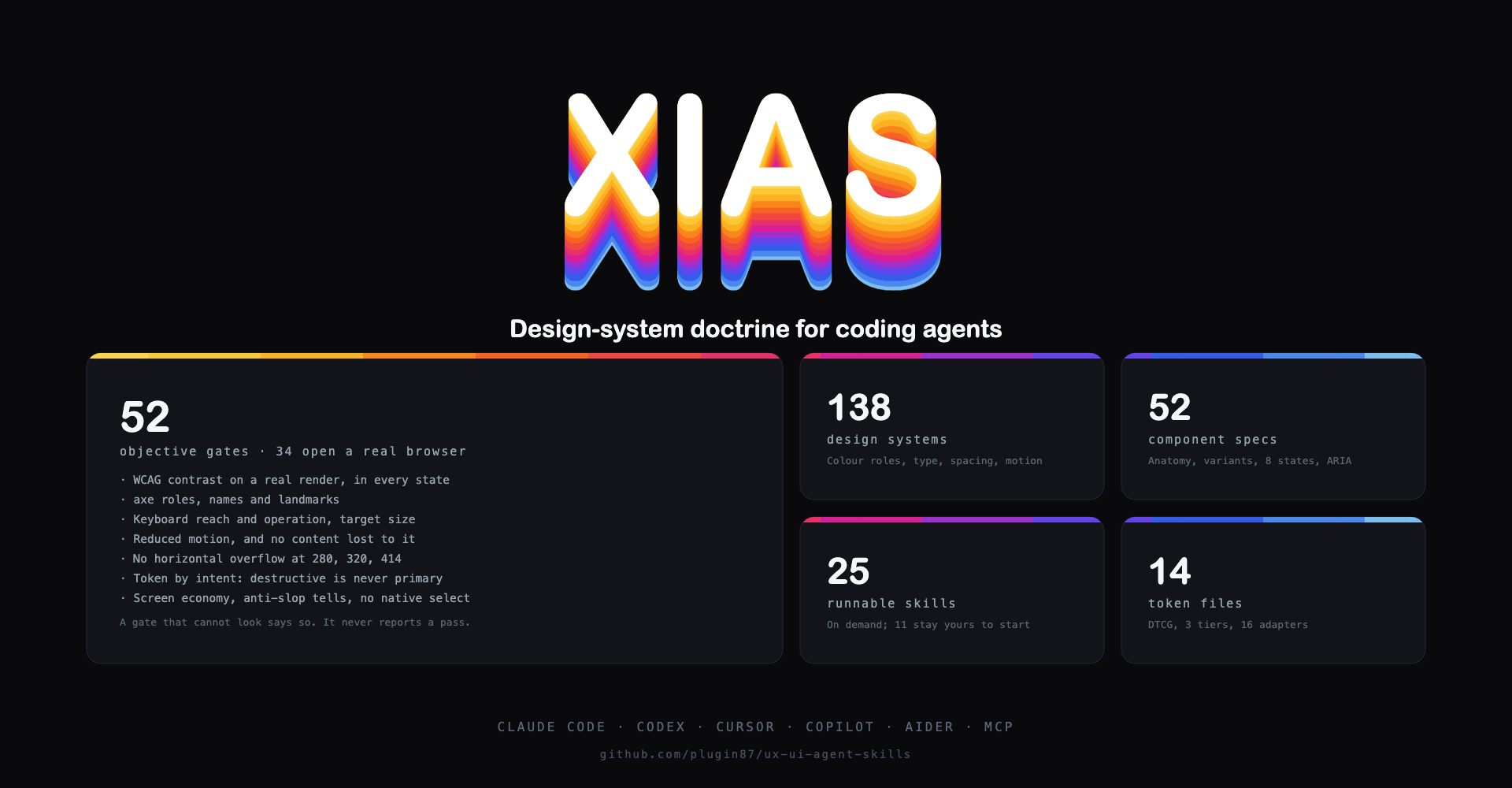
- • It is part of a pack with 26 skills. Install only the ones you need with --skill to keep triggers precise.
- • If two skills overlap, mention the one you want by name.
Questions about Image To Code
What does the Image To Code skill do?
Turn a reference image, screenshot, or mockup into token-driven, accessible code. Infer the design system from the reference (palette, type scale, spacing, radius, layout archetype), map it to the 3-tier tokens, rebuild it, then verify with the kit's gates. Use when the user provides a design/screenshot and wants matching UI code.
How do I install Image To Code?
Run "npx skills add plugin87/ux-ui-agent-skills --skill image-to-code" in your project. The skills CLI installs it for Claude Code, Cursor, Codex and 70+ other agents. In Claude on the web, upload the skill folder as a ZIP under Customize > Skills.
Does Image To Code work in Cursor and Codex?
Yes. Image To Code uses the open SKILL.md format, so it works in Claude Code, Claude, Cursor, OpenAI Codex, Gemini CLI, GitHub Copilot and other agents that support agent skills.
Is Image To Code free?
Image To Code is open source on GitHub under the MIT license. It is free to install; check the license before commercial use.
Who made Image To Code?
Image To Code is published by plugin87 in the plugin87/ux-ui-agent-skills repository, together with 25 other skills.