Egonex-AI
Install Understand Chat
Pick your agent. Every command is ready to paste.
npx skills add Egonex-AI/Understand-Anything --skill understand-chatThe open skills CLI detects your agents (Claude Code, Cursor, Codex and 70+ more) and installs to the right folder. Add -g to install globally.
01
Install it
Run the command above, or upload the folder in Claude.
02
Ask naturally
Describe the task. Your agent loads understand-chat when the request matches its description.
03
Name it if needed
If it does not trigger, say “use the understand-chat skill”. In Codex, type $understand-chat.
The skill itself
SKILL.md
/understand-chat
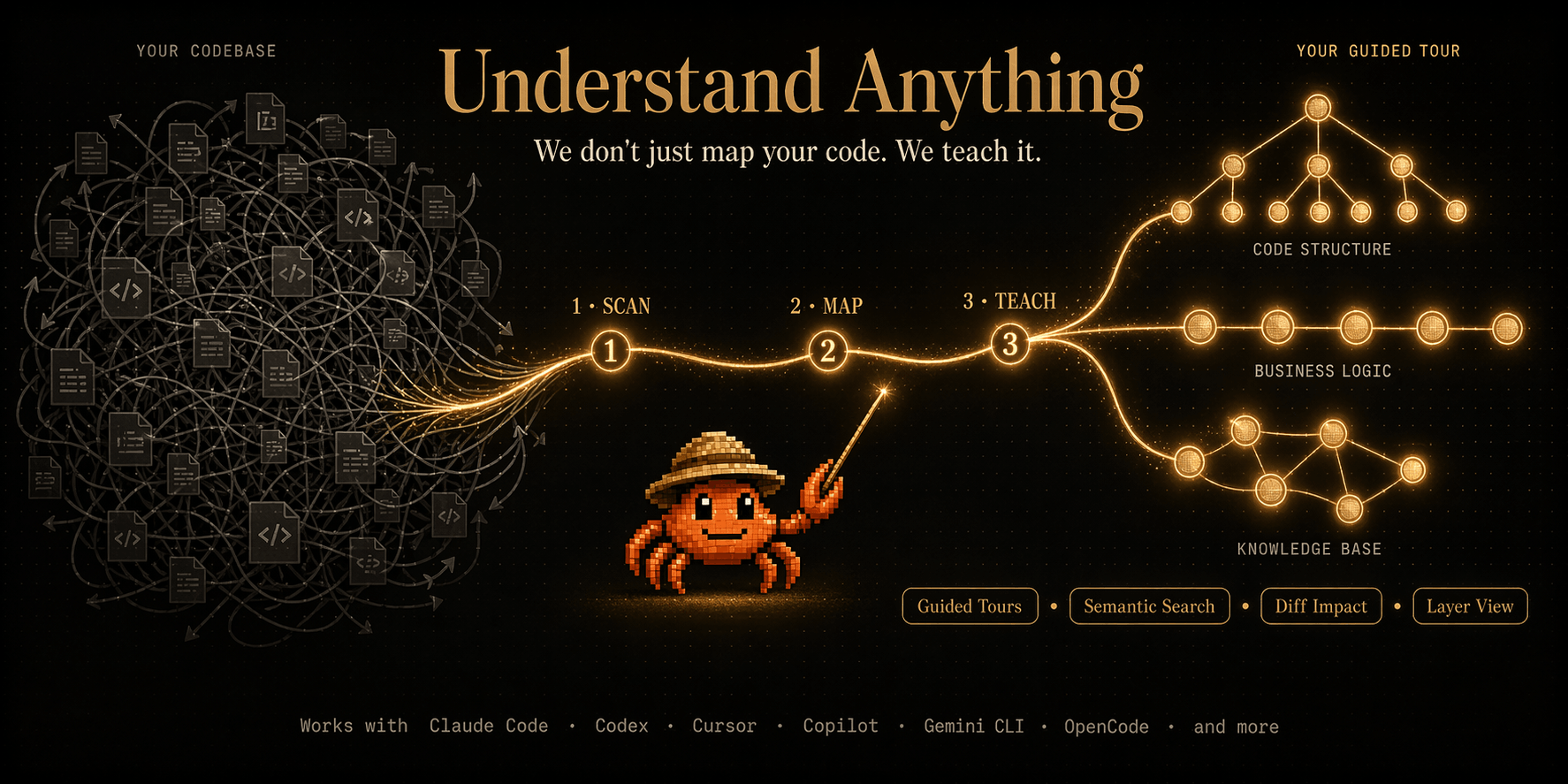
Answer questions about this codebase using the knowledge graph in the project's data directory (.ua/knowledge-graph.json, or the legacy .understand-anything/knowledge-graph.json when that directory is present).
Graph Structure Reference
The knowledge graph JSON has this structure:
project— {name, description, languages, frameworks, analyzedAt, gitCommitHash}nodes[]— each has {id, type, name, filePath?, summary, tags[], complexity, languageNotes?}- Code node types: file, function, class, module, concept
- Non-code node types: config, document, service, table, endpoint, pipeline, schema, resource
- Domain/knowledge node types: domain, flow, step, article, entity, topic, claim, source
- IDs use the node type as prefix, e.g.
file:path,function:path:name,config:path,article:path
edges[]— each has {source, target, type, direction, weight}- Key types: imports, contains, calls, depends_on, configures, documents, deploys, triggers, contains_flow, flow_step, related, cites
layers[]— each has {id, name, description, nodeIds[]}tour[]— each has {order, title, description, nodeIds[]}
How to Read Efficiently
- Use Grep to search within the JSON for relevant entries BEFORE reading the full file
- Only read sections you need — don't dump the entire graph into context
- Node names and summaries are the most useful fields for understanding
- Edges tell you how components connect — follow imports and calls for dependency chains
Instructions
Resolve the data directory
$UA_DIR. RunUA_DIR=$([ -d .understand-anything ] && echo .understand-anything || echo .ua)— this is the legacy.understand-anything/when it already exists, otherwise the new.ua/. Check that$UA_DIR/knowledge-graph.jsonexists in the current project root. If not, tell the user to run/understandfirst.Check graph freshness before using graph-derived context:
- Read
project.gitCommitHashfrom the graph metadata asGRAPH_COMMIT_RAW. Resolve it as a commit before using it in any Git diff, then compare it withgit rev-parse HEADand inspect project-scoped committed and working-tree changes from the project root:GRAPH_COMMIT=$(git rev-parse --verify --end-of-options "${GRAPH_COMMIT_RAW}^{commit}" 2>/dev/null) git rev-parse HEAD git diff --name-only "$GRAPH_COMMIT" HEAD -- . git diff --cached --name-only -- . git diff --name-only -- . git ls-files --others --exclude-standard -- . - The
-- .pathspec is required: commits that only touch a sibling monorepo project must not make this graph stale. A hash mismatch alone is not stale when the project diff is empty. - Ignore the selected data directory (
.ua/or legacy.understand-anything/) in every command's output because it contains generated graph artifacts, not project source drift. - If the committed diff or any working-tree command reports project files, warn before answering that graph-derived context may omit those changes. Suggest: Run
/understandto refresh the graph. - Run the commit diff only when
GRAPH_COMMIT_RAWresolves successfully. If the graph commit or Git metadata is missing, invalid, or unavailable, give a brief best-effort warning and continue instead of blocking.
- Read
Read project metadata only — use Grep or Read with a line limit to extract just the
"project"section from the top of the file for context (name, description, languages, frameworks).Search for relevant nodes — use Grep to search the knowledge graph file for the user's query keywords: "$ARGUMENTS"
- Search
"name"fields:grep -i "query_keyword"in the graph file - Search
"summary"fields for semantic matches - Search
"tags"arrays for topic matches - Note the
idvalues of all matching nodes
- Search
Find connected edges — for each matched node ID, Grep for that ID in the
edgessection to find:- What it imports or depends on (downstream)
- What calls or imports it (upstream)
- This gives you the 1-hop subgraph around the query
Read layer context — Grep for
"layers"to understand which architectural layers the matched nodes belong to.Answer the query using only the relevant subgraph:
- Reference specific files, functions, and relationships from the graph
- Explain which layer(s) are relevant and why
- Be concise but thorough — link concepts to actual code locations
- If the query doesn't match any nodes, say so and suggest related terms from the graph
Tips for Understand Chat
- • Start a fresh session after installing so your agent picks up the new skill.
- • It is part of a pack with 9 skills. Install only the ones you need with --skill to keep triggers precise.
- • If two skills overlap, mention the one you want by name.
Questions about Understand Chat
What does the Understand Chat skill do?
Use when you need to ask questions about a codebase or understand code using a knowledge graph
How do I install Understand Chat?
Run "npx skills add Egonex-AI/Understand-Anything --skill understand-chat" in your project. The skills CLI installs it for Claude Code, Cursor, Codex and 70+ other agents. In Claude on the web, upload the skill folder as a ZIP under Customize > Skills.
Does Understand Chat work in Cursor and Codex?
Yes. Understand Chat uses the open SKILL.md format, so it works in Claude Code, Claude, Cursor, OpenAI Codex, Gemini CLI, GitHub Copilot and other agents that support agent skills.
Is Understand Chat free?
Understand Chat is open source on GitHub under the MIT license. It is free to install; check the license before commercial use.
Who made Understand Chat?
Understand Chat is published by Egonex-AI in the Egonex-AI/Understand-Anything repository, together with 8 other skills.