Egonex-AI
Install Understand Domain
Pick your agent. Every command is ready to paste.
npx skills add Egonex-AI/Understand-Anything --skill understand-domainThe open skills CLI detects your agents (Claude Code, Cursor, Codex and 70+ more) and installs to the right folder. Add -g to install globally.
01
Install it
Run the command above, or upload the folder in Claude.
02
Ask naturally
Describe the task. Your agent loads understand-domain when the request matches its description.
03
Name it if needed
If it does not trigger, say “use the understand-domain skill”. In Codex, type $understand-domain.
The skill itself
SKILL.md
/understand-domain
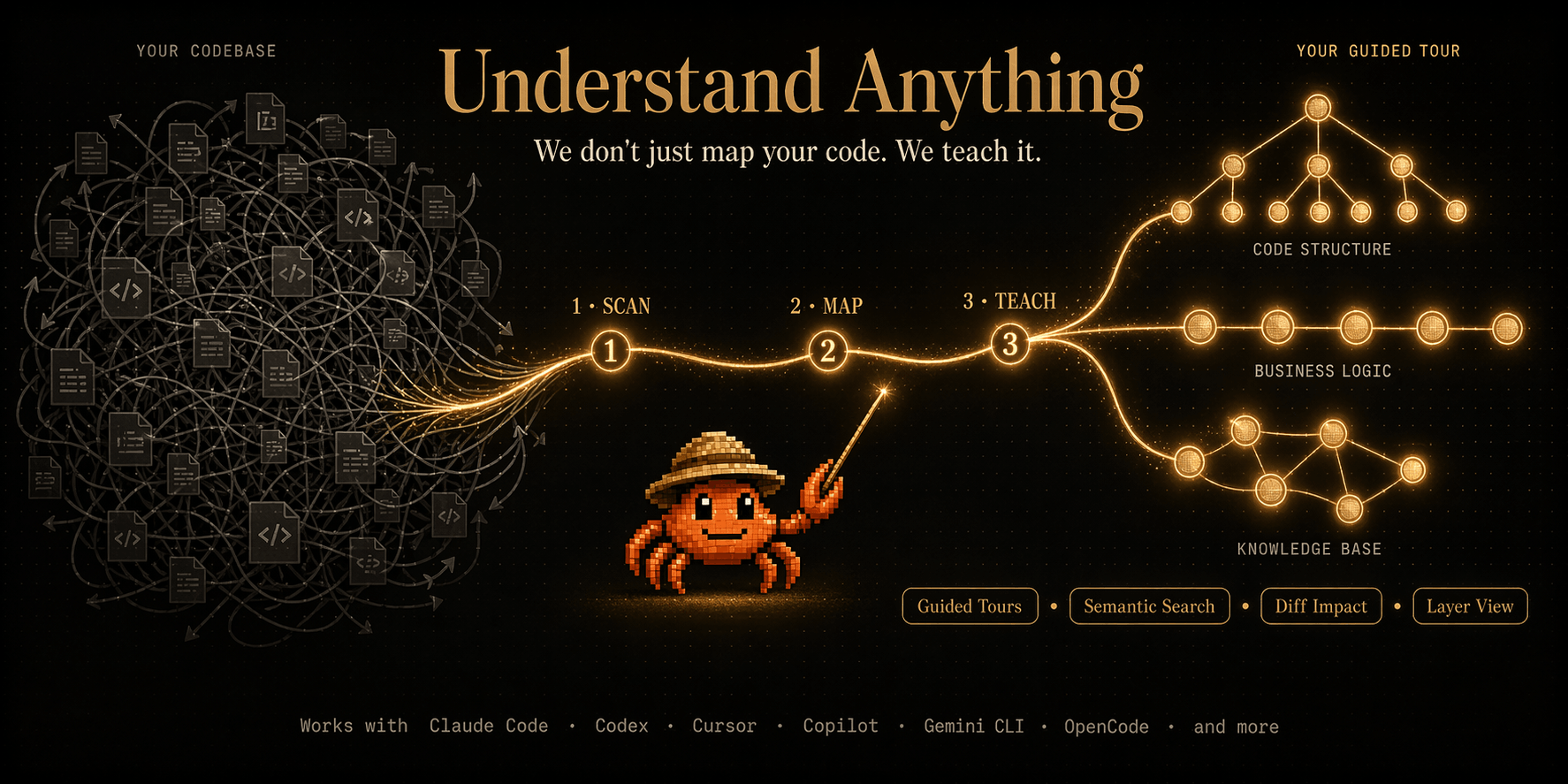
Extracts business domain knowledge — domains, business flows, and process steps — from a codebase and produces an interactive horizontal flow graph in the dashboard.
How It Works
- If a knowledge graph already exists (
.ua/knowledge-graph.json, or the legacy.understand-anything/knowledge-graph.jsonwhen that directory is present), derives domain knowledge from it (cheap, no file scanning) - If no knowledge graph exists, performs a lightweight scan: file tree + entry point detection + sampled files
- Use
--fullflag to force a fresh scan even if a knowledge graph exists
Instructions
Phase 0: Resolve PROJECT_ROOT
Set PROJECT_ROOT to the current working directory.
Worktree redirect. If PROJECT_ROOT is inside a git worktree (not the main checkout), redirect output to the main repository root. Worktrees managed by Claude Code are ephemeral — the data directory (.ua/, or legacy .understand-anything/) written there is destroyed when the session ends, taking the domain graph with it (issue #133). Detect a worktree by comparing git rev-parse --git-dir against git rev-parse --git-common-dir; in a normal checkout or submodule they resolve to the same path, in a worktree they differ and the parent of --git-common-dir is the main repo root.
COMMON_DIR=$(git -C "$PROJECT_ROOT" rev-parse --git-common-dir 2>/dev/null)
GIT_DIR=$(git -C "$PROJECT_ROOT" rev-parse --git-dir 2>/dev/null)
if [ -n "$COMMON_DIR" ] && [ -n "$GIT_DIR" ]; then
  COMMON_ABS=$(cd "$PROJECT_ROOT" && cd "$COMMON_DIR" 2>/dev/null && pwd -P)
  GIT_ABS=$(cd "$PROJECT_ROOT" && cd "$GIT_DIR" 2>/dev/null && pwd -P)
  if [ -n "$COMMON_ABS" ] && [ "$COMMON_ABS" != "$GIT_ABS" ]; then
    MAIN_ROOT=$(dirname "$COMMON_ABS")
    if [ -d "$MAIN_ROOT" ] && [ "${UNDERSTAND_NO_WORKTREE_REDIRECT:-0}" != "1" ]; then
      echo "[understand-domain] Detected git worktree at $PROJECT_ROOT"
      echo "[understand-domain] Redirecting output to main repo root: $MAIN_ROOT"
      echo "[understand-domain] (Set UNDERSTAND_NO_WORKTREE_REDIRECT=1 to keep PROJECT_ROOT as the worktree.)"
      PROJECT_ROOT="$MAIN_ROOT"
    fi
  fi
fi
Use $PROJECT_ROOT (not the bare CWD) for every reference to "the current project" / <project-root> in subsequent phases.
Resolve the data directory $UA_DIR. All Understand-Anything artifacts live in the project's data directory. Resolve it once, now that $PROJECT_ROOT is known, and reuse $UA_DIR for every read and write in later phases:
UA_DIR="$PROJECT_ROOT/$([ -d "$PROJECT_ROOT/.understand-anything" ] && echo .understand-anything || echo .ua)"
This keeps the legacy .understand-anything/ directory when it already exists (existing projects keep working with no migration) and uses the new .ua/ otherwise. Because each phase may run in a fresh shell, carry $UA_DIR forward like $PROJECT_ROOT, re-resolving it with the line above if a later command block needs it.
Important: do not assume the plugin root is simply two directories above the skill path string. In many installations ~/.agents/skills/understand-domain is a symlink into the real plugin checkout. Prefer runtime-provided plugin roots first (for Claude), then fall back to universal symlinks, skill symlink resolution, and common clone-based install paths.
Resolve the plugin root like this. Substitute <SKILL_DIR> with this skill's directory (the base directory your platform reported when loading this skill) — this is how plugin installs with no fixed location, such as Devin's, are found:
SKILL_DIR_RELATIVE=$(cd -P "<SKILL_DIR>" 2>/dev/null && cd ../.. && pwd || echo "")
SKILL_REAL=$(realpath ~/.agents/skills/understand-domain 2>/dev/null || readlink -f ~/.agents/skills/understand-domain 2>/dev/null || echo "")
SELF_RELATIVE=$([ -n "$SKILL_REAL" ] && cd "$SKILL_REAL/../.." 2>/dev/null && pwd || echo "")
COPILOT_SKILL_REAL=$(realpath ~/.copilot/skills/understand-domain 2>/dev/null || readlink -f ~/.copilot/skills/understand-domain 2>/dev/null || echo "")
COPILOT_SELF_RELATIVE=$([ -n "$COPILOT_SKILL_REAL" ] && cd "$COPILOT_SKILL_REAL/../.." 2>/dev/null && pwd || echo "")

PLUGIN_ROOT=""
for candidate in \
  "${CLAUDE_PLUGIN_ROOT}" \
  "${DEVIN_PLUGIN_ROOT}" \
  "$SKILL_DIR_RELATIVE" \
  "$HOME/.understand-anything-plugin" \
  "$SELF_RELATIVE" \
  "$COPILOT_SELF_RELATIVE" \
  "$HOME/.codex/understand-anything/understand-anything-plugin" \
  "$HOME/.opencode/understand-anything/understand-anything-plugin" \
  "$HOME/.pi/understand-anything/understand-anything-plugin" \
  "$HOME/understand-anything/understand-anything-plugin"; do
  if [ -n "$candidate" ] && [ -f "$candidate/package.json" ] && [ -f "$candidate/pnpm-workspace.yaml" ]; then
    PLUGIN_ROOT="$candidate"
    break
  fi
done

if [ -z "$PLUGIN_ROOT" ]; then
  echo "Error: Cannot find the understand-anything plugin root."
  echo "Checked:"
  echo "  - ${CLAUDE_PLUGIN_ROOT:-<unset CLAUDE_PLUGIN_ROOT>}"
  echo "  - ${DEVIN_PLUGIN_ROOT:-<unset DEVIN_PLUGIN_ROOT>}"
  echo "  - ${SKILL_DIR_RELATIVE:-<unresolved path derived from the skill directory>}"
  echo "  - $HOME/.understand-anything-plugin"
  echo "  - ${SELF_RELATIVE:-<unresolved path derived from ~/.agents/skills/understand-domain>}"
  echo "  - ${COPILOT_SELF_RELATIVE:-<unresolved path derived from ~/.copilot/skills/understand-domain>}"
  echo "  - $HOME/.codex/understand-anything/understand-anything-plugin"
  echo "  - $HOME/.opencode/understand-anything/understand-anything-plugin"
  echo "  - $HOME/.pi/understand-anything/understand-anything-plugin"
  echo "  - $HOME/understand-anything/understand-anything-plugin"
  echo "Make sure the plugin is installed correctly."
  exit 1
fi
Use $PLUGIN_ROOT for every reference to agent definitions in subsequent phases.
Phase 1: Detect Existing Graph
- Check if
$UA_DIR/knowledge-graph.jsonexists - If it exists AND
--fullwas NOT passed, check freshness before deriving from it:- Read
project.gitCommitHashfrom the graph metadata asGRAPH_COMMIT_RAW. Change to$PROJECT_ROOT, resolve it as a commit before using it in any Git diff, compare the resolved commit withgit rev-parse HEAD, and inspect project-scoped committed and working-tree changes:GRAPH_COMMIT=$(git rev-parse --verify --end-of-options "${GRAPH_COMMIT_RAW}^{commit}" 2>/dev/null) git rev-parse HEAD git diff --name-only "$GRAPH_COMMIT" HEAD -- . git diff --cached --name-only -- . git diff --name-only -- . git ls-files --others --exclude-standard -- . - The
-- .pathspec is required: commits that only touch a sibling monorepo project must not make this graph stale. A hash mismatch alone is not stale when the project diff is empty. - Ignore the selected data directory (
.ua/or legacy.understand-anything/) in every command's output because it contains generated graph artifacts, not project source drift. - If the committed diff or any working-tree command reports project files, warn that domain extraction may omit those changes. Suggest: Run
/understandto refresh the knowledge graph. - Run the commit diff only when
GRAPH_COMMIT_RAWresolves successfully. If the graph commit or Git metadata is missing, invalid, or unavailable, give a brief best-effort warning and continue instead of blocking.
- Read
- After that preflight, proceed to Phase 3 (derive from graph).
- Otherwise, proceed to Phase 2 (lightweight scan). When
--fullis used, skip this preflight because the command performs a fresh scan instead of consuming the existing graph.
Phase 2: Lightweight Scan (Path 1)
The preprocessing script does NOT produce a domain graph — it produces raw material (file tree, entry points, exports/imports) so the domain-analyzer agent can focus on the actual domain analysis instead of spending dozens of tool calls exploring the codebase. Think of it as a cheat sheet: cheap Python preprocessing → expensive LLM gets a clean, small input → better results for less cost.
- Run the preprocessing script bundled with this skill, passing
$PROJECT_ROOTfrom Phase 0:
This outputspython ./extract-domain-context.py "$PROJECT_ROOT"$UA_DIR/intermediate/domain-context.jsoncontaining:- File tree (respecting
.gitignore) - Detected entry points (HTTP routes, CLI commands, event handlers, cron jobs, exported handlers)
- File signatures (exports, imports per file)
- Code snippets for each entry point (signature + first few lines)
- Project metadata (package.json, README, etc.)
- File tree (respecting
- Read the generated
domain-context.jsonas context for Phase 4 - Proceed to Phase 4
Phase 3: Derive from Existing Graph (Path 2)
- Read
$UA_DIR/knowledge-graph.json - Format the graph data as structured context:
- All nodes with their types, names, summaries, and tags
- All edges with their types (especially
calls,imports,contains) - All layers with their descriptions
- Tour steps if available
- This is the context for the domain analyzer — no file reading needed
- Proceed to Phase 4
Phase 4: Domain Analysis
- Read the domain-analyzer agent prompt from
$PLUGIN_ROOT/agents/domain-analyzer.md - Dispatch a subagent with the domain-analyzer prompt + the context from Phase 2 or 3
- The agent writes its output to
$UA_DIR/intermediate/domain-analysis.json
Phase 5: Validate and Save
- Read the domain analysis output
- Validate using the standard graph validation pipeline (the schema now supports domain/flow/step types)
- If validation fails, log warnings but save what's valid (error tolerance)
- Save to
$UA_DIR/domain-graph.json - Clean up
$UA_DIR/intermediate/domain-analysis.jsonand$UA_DIR/intermediate/domain-context.json
Phase 6: Launch Dashboard
- Auto-trigger
/understand-dashboardto visualize the domain graph - The dashboard will detect
domain-graph.jsonand show the domain view by default
Tips for Understand Domain
- • Start a fresh session after installing so your agent picks up the new skill.
- • This skill ships scripts. Read them before the first run, and run it in a project without secrets first.
- • It is part of a pack with 9 skills. Install only the ones you need with --skill to keep triggers precise.
- • If two skills overlap, mention the one you want by name.
Questions about Understand Domain
What does the Understand Domain skill do?
Extract business domain knowledge from a codebase and generate an interactive domain flow graph. Works standalone (lightweight scan) or derives from an existing /understand knowledge graph.
How do I install Understand Domain?
Run "npx skills add Egonex-AI/Understand-Anything --skill understand-domain" in your project. The skills CLI installs it for Claude Code, Cursor, Codex and 70+ other agents. In Claude on the web, upload the skill folder as a ZIP under Customize > Skills.
Does Understand Domain work in Cursor and Codex?
Yes. Understand Domain uses the open SKILL.md format, so it works in Claude Code, Claude, Cursor, OpenAI Codex, Gemini CLI, GitHub Copilot and other agents that support agent skills.
Is Understand Domain free?
Understand Domain is open source on GitHub under the MIT license. It is free to install; check the license before commercial use.
Who made Understand Domain?
Understand Domain is published by Egonex-AI in the Egonex-AI/Understand-Anything repository, together with 8 other skills.